
Introduction
Commerce has always evolved with technology. The internet connected buyers and sellers globally, mobile devices put shopping in our pockets, and digital wallets made checkout nearly invisible. The next transformation is beginning to emerge across the payments ecosystem: artificial intelligence is no longer limited to answering questions. It is becoming an active participant in commerce — discovering products, comparing prices, negotiating offers, and completing purchases on behalf of consumers and businesses.
This shift is known as agentic commerce. Instead of navigating websites themselves, customers define an objective while an AI agent manages the execution within predefined rules, budgets, and preferences. For retailers, travel companies, and enterprise procurement teams alike, it changes how commerce is initiated, how payments are authorized, and how trust is established between people, merchants, payment providers, and intelligent software. This guide explains what agentic commerce is, how AI‑driven payments stay secure, and how merchants can prepare.
What is Agentic Commerce?
Agentic commerce is a model of digital commerce in which intelligent AI agents autonomously discover, evaluate, negotiate, purchase, and manage products or services on behalf of users, while operating within clearly defined policies and permissions.
Those boundaries are set by the user or organization and typically include:
- Spending limits
- Preferred brands & merchants
- Delivery requirements
- Corporate procurement policies
- Geographic restrictions
- Risk tolerance
- Approved payment methods
The policy boundary: parameters a user or organization sets before an agent can transact.
Once these parameters are defined, the agent monitors available options and executes transactions whenever the conditions are met. The focus shifts from managing interactions to achieving outcomes — and merchants increasingly compete for the attention of intelligent purchasing agents, not just human shoppers.
From Click‑based to Goal‑based Commerce
For decades, e‑commerce innovation has focused on reducing friction — every improvement, from saved credentials to one‑click checkout, shortened the distance between discovering a product and buying it. Agentic commerce changes the objective. The traditional journey is compressed into an autonomous workflow.
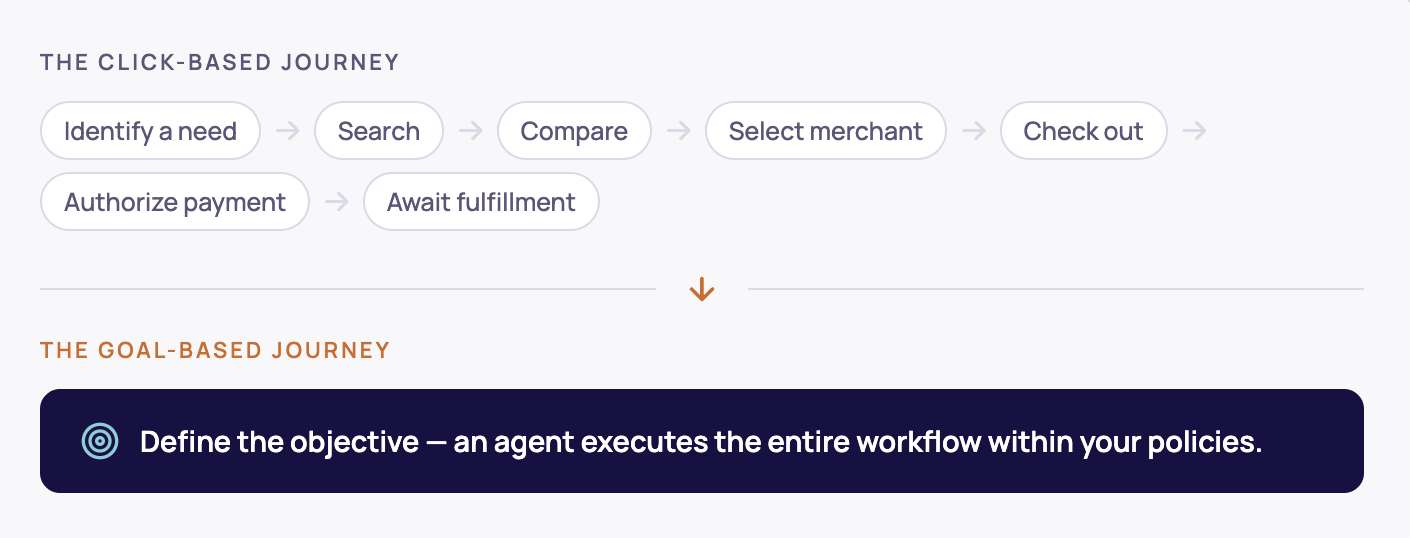
An AI shopping agent can rapidly evaluate numerous merchants simultaneously, weighing historical pricing, inventory availability, delivery speed, reviews, loyalty rewards, return policies, and budget constraints in seconds. Businesses are no longer competing solely for customer attention; they are competing for algorithmic preference. Structured product data, API accessibility, pricing transparency, and fulfillment reliability become as important as website design or advertising.
Agentic AI vs. Generative AI
The terms are often used interchangeably, but they serve different purposes. Generative AI creates content in response to prompts — text, summaries, images, answers. Agentic AI pursues objectives.
Generative AI: Creates in response to prompts
Recommends several hotels for a business trip — then hands the work back to you.
Agentic AI: Pursues objectives
Compares thousands of listings, books the flight and room, selects the right payment method, and keeps monitoring rates after booking.
The difference is not simply intelligence — it is autonomy.
Traditional Commerce vs. Agentic Commerce
The shift is more than faster checkout; it is commerce redesigned for collaboration between people and intelligent software.
| Traditional Commerce | Agentic Commerce |
|---|---|
| Human-driven shopping | AI-assisted purchasing |
| Manual product discovery | Autonomous product discovery |
| Customer compares merchants | AI evaluates thousands of options |
| Manual checkout | Intelligent, API-driven checkout |
| Human authentication | Trusted agent verification |
| One-time transaction | End-to-end lifecycle management |
Why Payments Become the Foundation
Traditional payment systems were designed around human authentication — logins, multifactor prompts, biometrics. Agentic commerce introduces a new participant, and before an AI agent completes a purchase, merchants and payment providers must be able to answer:
- Is this a trusted AI agent?
- Has the user delegated authority?
- Is the transaction within approved spending policies?
- Has consent been maintained throughout the purchase?
Without reliable answers, autonomous commerce cannot scale safely. Payment infrastructure is therefore evolving beyond authorization and settlement toward identity verification, delegated consent, and trust frameworks built for AI‑initiated transactions. Notably, agentic commerce does not replace today's payment ecosystem — banks still issue credentials, processors still authorize, and networks still route payments. What changes is the interaction layer: agents communicate with merchant systems through APIs, structured data, and secure payment protocols, and the industry is extending familiar capabilities such as tokenization, authentication, and fraud prevention rather than building new rails.
The Agentic Trust Stack: A Four‑layer Framework
For decades, payment networks assumed the person initiating a payment is the person authorizing it. Agentic commerce breaks that assumption, so trust must be engineered in layers.
- Trusted digital identity
Every AI shopping agent needs a verifiable identity so merchants can distinguish trusted purchasing agents from malicious bots attempting credential stuffing, scraping, or payment fraud. Rather than relying on IP addresses or browser fingerprints, trusted agents authenticate through identity frameworks designed for machine‑to‑machine commerce — the digital equivalent of verifying a person before approving a transaction. - Delegated authority
AI agents cannot independently decide how money is spent. Every purchase must trace to authority delegated by the person or business that owns the agent — spending limits, approved merchants, product categories, time‑based permissions, and procurement policies. The agent remains an extension of the customer, not an independent decision‑maker. - Continuous consent
Traditional e‑commerce captures consent once, at checkout. Agentic commerce requires it throughout the purchasing lifecycle. A consumer may authorize an assistant to reorder groceries or rebook cancelled flights while barring it from exceeding monthly budgets. Consent becomes an ongoing governance model that can be updated, refined, or revoked as circumstances change. - Tokenized, policy‑bound credentials
A common misconception is that AI systems gain unrestricted access to payment credentials. The opposite is true: credentials are replaced with secure digital tokens bound to a specific agent and carrying built‑in controls — merchant categories, transaction frequency, geographic limits, expiration rules. PCI DSS still governs how payment data is protected: the AI decides what to purchase, while PCI‑compliant payment infrastructure determines how payment is executed.
The agentic trust stack — four layers between an agent's intent and an executed payment.
Why This Matters for Merchants
AI agents evaluate merchants differently than people do. Instead of responding to advertising or design, they prioritize structured product information, pricing transparency, API accessibility, fulfillment reliability, and clear customer policies. The competitive advantage shifts toward becoming the preferred destination for trusted AI agents acting on behalf of customers. The impact will be felt across industries:
- Retail & e‑commerce
AI‑ready product catalogs, frictionless tokenized payments, accurate inventory, and reliable fulfillment determine how easily agents can discover and transact with a store. - Travel & hospitality
Agents can coordinate flights, hotels, and rebooking of disrupted travel in a single workflow while completing secure payments across providers. - Enterprise procurement
Possibly the largest opportunity: corporate purchasing already runs on structured policies, preferred suppliers, and approval workflows — a natural fit for autonomous decision‑making.
Governance Will Define Success
Technology alone will not determine the outcome — governance will. Organizations should establish clear answers early: What purchasing decisions can an agent make independently? Which transactions require additional approval? How is delegated authority documented, how are disputes investigated, and who is accountable for AI‑initiated transactions? Businesses that answer these questions early build stronger customer confidence while reducing operational risk.
Agentic Commerce Readiness Checklist
- Expose product catalogs, pricing, inventory, and order status through secure APIs
- Maintain machine‑readable, structured product data
- Implement payment tokenization for agent‑initiated transactions
- Support trusted agent authentication and verification
- Keep pricing and policies transparent and consistent
- Automate fulfillment and order‑status updates
- Maintain comprehensive transaction and consent logging
- Define delegated‑authority and spending policies
- Establish cross‑functional governance (payments, security, compliance, legal)
- Keep sensitive payment data inside PCI‑compliant environments
Frequently asked questions
What is agentic commerce?
A model of digital commerce where AI agents autonomously discover, evaluate, purchase, and manage products or services on behalf of individuals or organizations, within predefined rules and permissions.
How is agentic commerce different from e‑commerce?
Traditional e‑commerce requires customers to complete every stage of the buying journey manually. Agentic commerce delegates much of that process to AI agents that make purchasing decisions within approved policies.
How do AI agents make payments?
Rather than accessing raw payment credentials, agents use tokenized payment methods, delegated permissions, and authenticated payment infrastructure to complete authorized transactions.
Are AI shopping agents secure?
They can be, when supported by trusted digital identities, tokenization, delegated authorization, fraud monitoring, and strong governance frameworks.
Why is tokenization important in agentic commerce?
Tokenization replaces sensitive credentials with secure tokens that carry built‑in spending controls, reducing fraud risk while allowing agents to transact safely.
What should merchants do today?
Modernize APIs, strengthen digital identity capabilities, implement tokenization, improve structured product data, and establish governance frameworks that support autonomous commerce.
Conclusion
Every major transformation in commerce has been driven by two forces: innovation and trust. Agentic commerce is the next stage — shifting commerce from human‑driven interactions to intelligent delegation. Success will depend on the industry's ability to build trust into every interaction: secure identities, interoperable standards, modern payment infrastructure, and governance that keeps autonomous systems transparent, accountable, and aligned with customer intent.
Organizations that begin preparing now gain more than a technological edge; they build the operational experience and customer confidence needed to compete as AI agents increasingly represent buyers. The future of commerce will not be measured by how quickly AI can complete a purchase — but by how confidently people can trust it to make the right one.
"Agentic commerce represents one of the most significant shifts our industry has witnessed since the rise of e‑commerce. As AI moves from assisting customers to acting on their behalf, our responsibility extends beyond enabling faster transactions; we must build an ecosystem founded on trust, transparency, security, and accountability."
- Andy Phillips, CEO
Primary sources: card‑network and industry materials on agentic payments — including Visa Intelligent Commerce and Mastercard Agent Pay announcements, the Agentic Commerce Protocol specification (OpenAI/Stripe), and PCI DSS (PCI Security Standards Council). This article is a plain‑language, vendor‑neutral summary; network rules and the merchant agreement govern.
Build on Payment Infrastructure That's Ready
Explore Cliq solutions for the foundations agentic commerce depends on.
So, what's next?
We're ready to get started.