
Introduction
Artificial intelligence is being used on both sides of the payments industry. Businesses use it to speed up operations and score risk. Fraudsters use it to write better phishing emails, clone voices, fabricate documents, and run campaigns that used to require a team of people.
The FBI’s Internet Crime Complaint Center recorded 1,008,597 complaints in 2025 and $20.877 billion in reported losses — a 26% increase over the previous year. For the first time, the FBI reported “AI Related” as a distinct complaint descriptor: in 2025, 22,364 complaints contained AI-related information, with approximately $893 million in associated adjusted losses (FBI, 2025 Internet Crime Report). The FBI cautions that many victims may not realize the extent to which AI was involved, so the reported AI-related figures should be treated as complaint-based indicators rather than a complete measure of AI-enabled fraud.
The more useful number sits underneath those headlines. Cyber-enabled fraud accounted for approximately 85% of all losses reported to IC3 in 2025, despite representing about 45% of complaints. The category covers schemes in which criminals use the internet or other technology to steal money, data, or identities, or to facilitate other fraudulent activity. Many of the highest-loss categories — including investment fraud, business email compromise, and impersonation — depend heavily on convincing a person to transfer money or disclose information.
That is what AI is getting better at manipulating, and it is why AI fraud prevention has become a payment security question rather than only a technology one. Defenses are shifting from static rule sets toward layered, adaptive ones.
This guide is published by Cliq, a payments-infrastructure company, as educational material. It is deliberately even-handed: as the sections ahead make clear, no payment provider’s tools prevent the social-engineering attacks that cause the most loss.
How this article is sourced. Quantitative figures come from the FBI’s Internet Crime Complaint Center (IC3). The synthetic-identity definition and mitigation discussion draw from Federal Reserve resources; identity-verification, authentication, and biometric guidance reference the FBI’s generative-AI advisory, the NIST Digital Identity Guidelines, and CISA guidance on multifactor authentication. Vendor security blogs, which were found to disagree with each other on the details, were not used. This is educational information, not legal, financial, or security advice.
Key Takeaways
- The FBI logged $20.877 billion in reported cybercrime losses in 2025, up 26% year over year, with “AI Related” reported as a distinct complaint descriptor for the first time — 22,364 complaints contained AI-related information, with roughly $893 million in associated losses (FBI IC3).
- In many payment-fraud schemes, AI amplifies established tactics rather than changing the underlying objective. Phishing, impersonation, and account takeover are long-standing; AI makes them cheaper, faster, and more convincing.
- Business email compromise alone accounted for $3.046 billion in reported losses in 2025, and much of it moves by wire transfer or ACH, where recovery may depend on rapid reporting and is not guaranteed.
- Many deepfake payment-fraud schemes target people and organizational processes rather than directly compromising payment-system security. The technology defeats a human’s judgment, not a merchant’s encryption.
- The Federal Reserve defines synthetic identity fraud as combining personally identifiable information to fabricate a person or entity in order to commit a dishonest act for gain (Federal Reserve). It is hard to detect because there may be no immediately identifiable victim to report the fraud.
- No single control stops AI-enabled fraud. Layered defenses — verification procedures, authentication, behavioral analysis, and human judgment — are what reduce exposure.
Working definition: AI-enabled payment fraud. In this article, AI-enabled payment fraud refers to fraudulent activity that uses artificial intelligence to deceive people or payment systems. Common examples include deepfake voice scams, synthetic identity fraud, AI-generated phishing campaigns, and automated account takeover attempts. Businesses use layered defenses — including verification procedures, authentication, behavioral analytics, and AI-assisted detection — to help identify and reduce these threats.
How is AI changing payment fraud?
The most important thing to understand is also the least dramatic: in many payment-fraud schemes, AI amplifies established tactics rather than changing the underlying objective. Most attacks described in this article existed before generative AI. What changed is the cost of executing them well.
Fraud used to be constrained by effort. A convincing phishing email required someone who could write convincingly in the target’s language. Impersonating an executive on a phone call required an impersonator. Fabricating a passable identity document required skill. AI tools have reduced many of those constraints and can make certain fraud campaigns easier to create and scale.
- Scam creation can be faster. AI tools can produce and revise messages rapidly, allowing criminals to test more variations.
- Phishing is personalized. Public information about a company and its staff can be turned into a message that references real projects, real names, and a real writing style.
- Voice can be cloned. Publicly available or compromised audio can be used to create increasingly convincing voice imitations; the quality and amount of source audio required vary by tool and circumstances.
- Documents can be fabricated more easily. Generative tools can assist in producing false identity documents, invoices, and letterhead, although quality and detectability vary.
- Campaigns can be automated. Some tasks can run continuously and at greater scale with less manual effort.
- Account takeover is assisted. Credential stuffing and social engineering are coordinated and iterated automatically.
The practical consequence: advice that relies primarily on spotting bad grammar or awkward phrasing is no longer reliable. Language quality should not be treated as a substitute for verification procedures.
What is deepfake payment fraud?
Deepfake, defined. A deepfake is synthetic audio, video, or imagery generated by AI to convincingly imitate a real person. In a payments context, deepfakes are used to impersonate executives, vendors, or customers in order to authorize or redirect a payment.
The attack pattern is consistent. Someone in finance receives a call, a voice message, or a video meeting request from a person they recognize — a CEO, a CFO, a known supplier. The request is to make a payment, or to change payment details already on file. The voice is right. The face may be right. The urgency is real, and manufactured.
What this looks like in practice
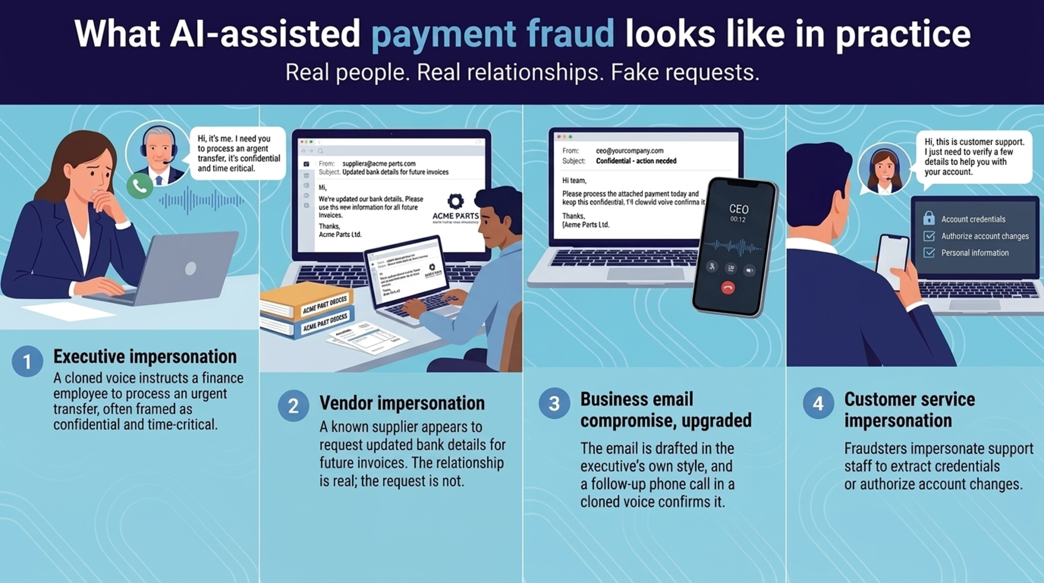
Notice what is not being attacked. In the scenarios described here, the attack generally does not require defeating encryption, penetrating a gateway, or directly compromising a payment system. They exploit human trust and organizational urgency — which is why the defenses that work against them are procedural as well as technological. An independent callback to a previously verified number can disrupt a voice-impersonation attempt because it does not rely on the incoming voice, video, or contact information alone. Payment controls such as approval thresholds and transaction monitoring may provide additional protection, but they should not replace independent verification.
What is synthetic identity fraud?
The Federal Reserve’s industry-recommended definition is direct. Synthetic identity fraud is the use of a combination of personally identifiable information to fabricate a person or entity, in order to commit a dishonest act for personal or financial gain.
In practice, a fraudster combines real information — often a legitimate Social Security number — with fabricated details such as a made-up name, address, or date of birth. The result is a person who does not exist but looks entirely plausible on paper.
The long game
Synthetic identity fraud is patient in a way most fraud is not. The identity is created, then used to open a small account. It behaves well. It pays on time. It builds a credit history and a transaction record over months or years. Then, once limits have been extended, it takes everything available at once and disappears.
Why it is so hard to detect
- There may be no immediately identifiable consumer victim. Because a synthetic identity can combine real and fabricated information, the account may not trigger the same prompt complaint as conventional identity theft. A real person whose information was used may still experience harm, while the lender or business may initially classify the resulting loss as ordinary credit loss.
- The history may appear legitimate because the account can make genuine, on-time payments while building credit over an extended period.
- Activity ramps gradually, so velocity checks and thresholds tuned for sudden anomalies do not fire.
- Traditional verification asks whether the data is real. For a synthetic identity, much of it is. The question that catches it is whether the data belongs together, which is a harder question.
The Federal Reserve’s own guidance points toward layered mitigation combining technological and manual analysis, together with information sharing across the industry — precisely because no single check catches this.
How is fraud prevention evolving?
The shift is from static rules toward layered defense. A rule is a fixed statement about what fraud looks like, and AI-enabled fraud changes shape faster than rules can be rewritten. Layering assumes each control will sometimes fail and arranges for the next one to catch what the last one missed.
It is worth being clear about where these layers sit, because the distinction is often blurred. Some controls live in the payment stack — encryption, tokenization, card-not-present authentication, transaction screening. These operate on the transaction itself, and they are real. These controls address only part of the fraud described in this article. A transaction-level control cannot prevent the cloned voice call or fraudulent message from reaching an accounts-payable employee, although authentication, approval rules, transaction monitoring, and provider controls may still help detect or interrupt the resulting payment.
Procedural and technical controls should reinforce one another. Independent verification and approval procedures address the social-engineering request itself, while authentication, transaction monitoring, account controls, and payment-provider tools can provide additional opportunities to detect or interrupt the transaction.
No layer, and no combination of layers, eliminates fraud. Claims that a product or control can eliminate fraud should be treated skeptically.
Behavioral analytics
Behavioral analytics can evaluate patterns such as typing rhythm, mouse movement, navigation patterns, device characteristics, and transaction history to identify deviations from expected behavior. Signals drawn from how a person physically interacts with a device are often described as behavioral biometrics. These techniques may provide useful indicators of anomalous activity, but their effectiveness varies by implementation, available data, and context, and they can produce false positives and false negatives.
Biometrics
Fingerprint, face, and device-based biometrics tie authentication to something harder to steal than a password. They are strong, and they are not a complete answer: biometrics can be spoofed with synthetic media, which is exactly why the next layer exists. Biometric data is also sensitive personal data, and collecting it carries privacy obligations that vary by jurisdiction.
Liveness detection
Liveness detection is designed to assess whether a biometric sample is likely to come from a real person present at that moment, rather than a photo, recording, AI-generated image, or other presentation attack. Techniques may include blink and micro-movement analysis, depth sensing, and challenge-response prompts. Results can vary by technology, implementation, and attack method, so liveness detection should be treated as one layer rather than a definitive determination.
AI fraud detection
AI fraud detection identifies unusual transaction patterns, surfaces anomalies a fixed rule would miss, and adapts as fraud patterns shift. It is genuinely useful and it is not magic. Models produce false positives, which decline legitimate customers, and false negatives, which let fraud through. Tuning that trade-off is a business decision, not a technical one — and it is a decision, not a setting that can be left alone.
Agentic AI in fraud operations
One emerging application is the use of AI agents to assist fraud teams with monitoring, alert prioritization, case-file preparation, and recommended responses. The appropriate level of human review depends on the decision, applicable requirements, customer impact, and the organization’s risk controls. Fraud decisions affect real customers and carry regulatory weight, so an agent that can recommend is useful, while an agent that can act unsupervised on customer accounts is a risk in its own right.
Fraud controls available through Cliq
The controls below sit in the payment layer. They are described here as capabilities, not as outcomes.
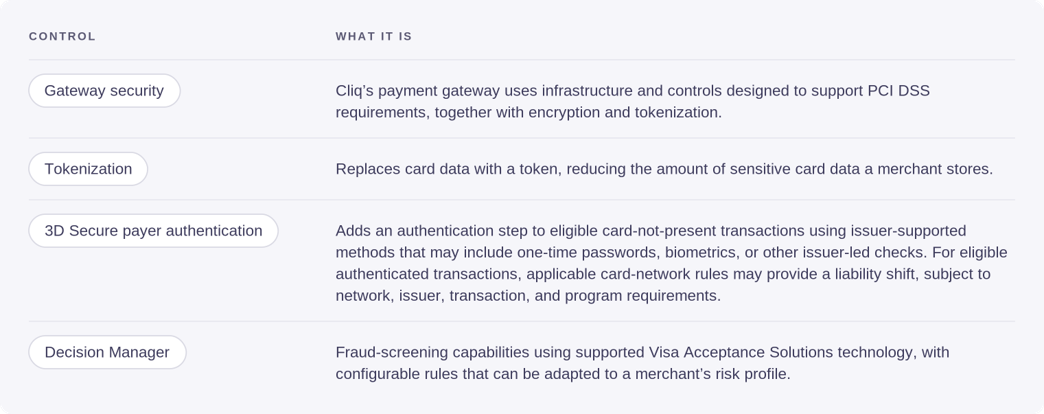
These are transaction-level controls, and the limits described earlier apply to them as they apply to any provider’s: they act on the transaction, not on the phone call. Merchants evaluating fraud tooling — from Cliq or anyone else — should ask what a control actually covers, what it does not, and what remains their own responsibility. No fraud control from any provider guarantees the prevention of fraud.
Matching defenses to modern fraud
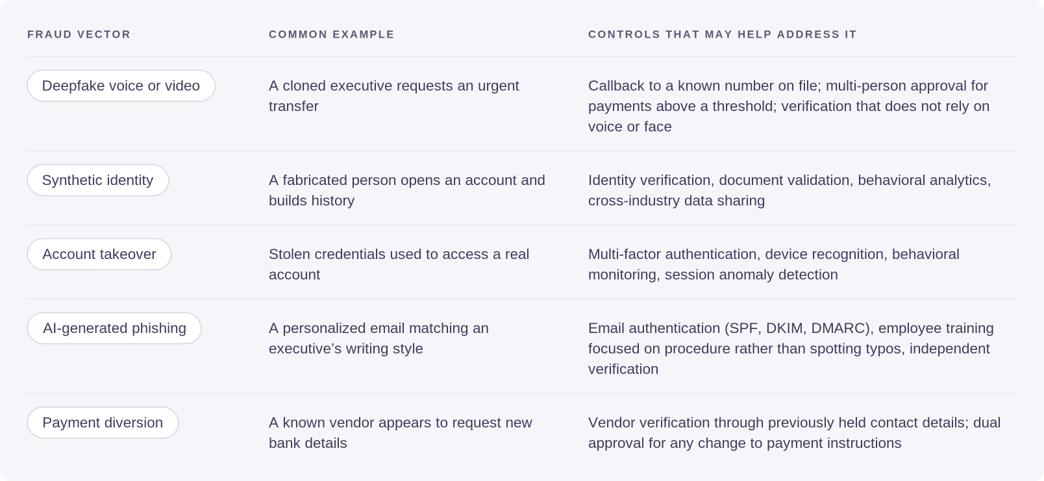
Read the right-hand column carefully. Much of what defeats these attacks is procedural. The callback directly addresses the impersonation attempt, while technical controls provide additional layers before, during, and after the payment.
What should businesses actually do?
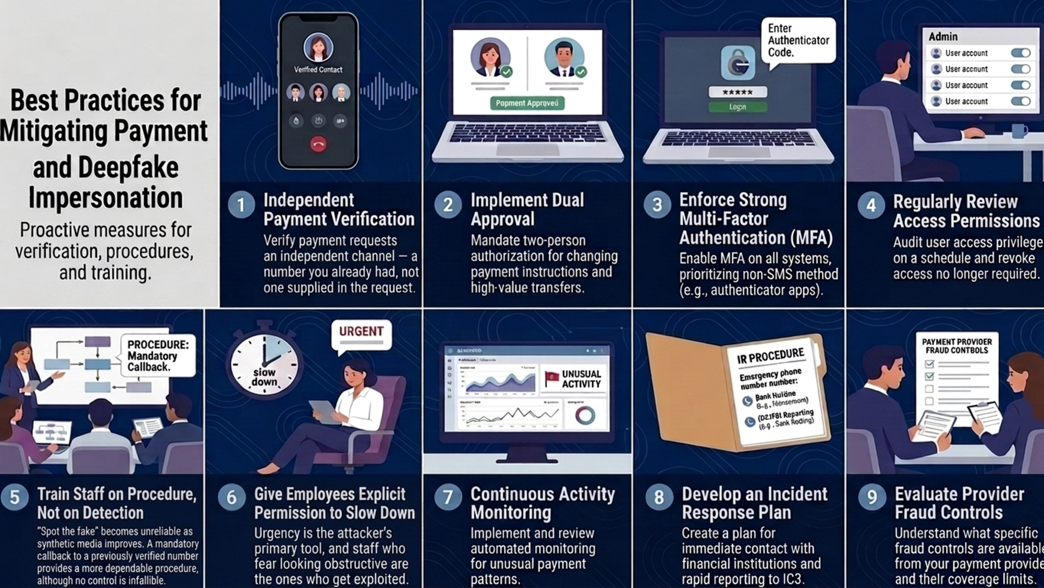
Many practical defenses against business fraud are procedural and can be implemented using controls that organizations may already have available — and they apply to accounts-payable teams, finance departments, and non-merchant organizations as much as to merchants.
Frequently Asked Questions
What is AI payment fraud?
AI payment fraud is fraudulent activity that uses artificial intelligence to deceive people or payment systems — deepfake voice scams, synthetic identities, AI-generated phishing, and automated account takeover. AI generally amplifies established fraud tactics — making them cheaper and more convincing — rather than changing the underlying objective.
What is a deepfake scam?
A deepfake scam uses AI-generated audio or video to impersonate someone the victim trusts — typically an executive or a known vendor — in order to authorize or redirect a payment. In many such scenarios, the attack targets a person's judgment or organizational processes rather than directly compromising payment-system security.
Can AI detect payment fraud?
AI can identify unusual patterns and adapt faster than fixed rules, and it is widely used in modern fraud-detection systems. It also produces false positives that decline real customers and false negatives that let fraud through. It is a strong layer, not a solution.
Can small businesses be targeted?
Yes. Small businesses can be targeted and may have fewer people available to separate payment initiation, verification, and approval. Some of the most useful defenses — such as callbacks to verified numbers and dual approval — can often be implemented with little or no additional technology spending, although they still require staff time, training, and consistent execution.
What is liveness detection?
Liveness detection is designed to assess whether a biometric sample is likely to come from a real person present at that moment, rather than a photo, recording, or AI-generated image. It is an additional authentication safeguard, but it does not guarantee detection of every presentation attack.
Can AI eliminate payment fraud completely?
No. No technology eliminates fraud, and any claim otherwise should be treated as a warning about the source. Attackers adapt to defenses, and many high-loss fraud schemes target human decisions, account access, or payment instructions rather than attempting to break encryption directly. The realistic goal is layered defense that reduces exposure and shortens the time to detection.
What is synthetic identity fraud?
The Federal Reserve defines it as combining personally identifiable information to fabricate a person or entity in order to commit a dishonest act for gain. Typically a real Social Security number is paired with a fabricated name and date of birth, and the identity builds a legitimate-looking history before the fraud is committed.
Conclusion
AI has changed the economics of fraud more than its underlying anatomy. Many attacks still work by convincing a person to move money. The FBI’s data shows that cyber-enabled fraud accounted for approximately 85% of reported losses in 2025, and many high-loss schemes succeed by manipulating a person into authorizing a payment, changing payment instructions, or disclosing information.
That should be a slightly reassuring conclusion, because it means the highest-value defenses are not exotic. Verify through a channel you control. Require two people to approve a change in payment instructions. Let staff slow down without penalty. Combine those procedures with authentication, transaction monitoring, access controls, and payment-provider tools so that each layer can catch what another misses.
The goal is not a system that cannot be attacked. It is an organization that notices quickly and has already decided what it will do.
Sources
- FBI Internet Crime Complaint Center — 2025 Internet Crime Report (complaints, losses, AI-related complaint descriptor, BEC losses, cyber-enabled share; published April 2026).
- FBI Internet Crime Complaint Center — Criminals Use Generative AI to Facilitate Financial Fraud (public service announcement on AI-enabled fraud tactics).
- Federal Reserve — Synthetic Identity Fraud (FedPayments Improvement) (industry-recommended definition and mitigation resources).
- NIST — SP 800-63-4 Digital Identity Guidelines (identity proofing, phishing-resistant authentication, and biometric/presentation-attack guidance).
- CISA — phishing-resistant multifactor authentication guidance (supports the stronger-MFA and authentication recoIntroduction
So, what's next?
We're ready to get started.