
Key takeaways
- Biometrics are a layer, not a fix: they add an authentication signal but do not eliminate fraud, account takeover, or chargebacks.
- Phone-based biometrics are common; the rest is early: fingerprint and face unlock in wallets is widespread, while palm, vein, and in-store face payment remain limited to specific providers and pilots.
- Biometric data creates its own obligations: laws such as Illinois BIPA, Colorado’s biometric amendment, and the EU GDPR add notice, consent, retention, and security requirements.
- Plan for failure: error rates vary by algorithm, device, environment, and population, so every deployment needs a tested, accessible non-biometric fallback.
Biometric payments in 2026: separating hype from reality
Biometric payments, which let a person confirm a payment with a fingerprint, face, palm, or other physical trait, are often marketed as the end of passwords and card fraud. The reality in 2026 is more nuanced. Fraud methods keep getting more sophisticated, so banks, merchants, card networks, and payment processors rely on layered controls. Biometric authentication is one of those layers, not a replacement for them.
This guide is written for merchants, payment product teams, and risk and compliance leaders. It explains how biometric payments work, where merchants may see real benefits, and which operational, privacy, security, legal, and accessibility limitations to evaluate before deployment.
Hype vs. reality at a glance
The table below summarizes the most common claims about biometric payments and what merchants should expect in practice.
| The hype | Biometrics eliminate payment fraud. | Biometric checkout is everywhere. | Using biometrics makes you compliant. | Biometrics work equally well for everyone. | Your biometric data never leaves the device. |
| The reality | They add an authentication signal. Account takeover, social engineering, spoofing, and chargebacks still require layered controls. | Fingerprint and face authentication on phones and wallets is common. Palm, vein, and in-store face payment remain limited to specific providers, markets, and pilots. | Biometric data triggers its own notice, consent, retention, deletion, and security obligations that vary by jurisdiction | Accuracy varies by algorithm, demographic group, device, and environment. Fallbacks and population-specific testing are essential. | It depends on the architecture. Many phone wallets match on the device; some merchant or provider systems store templates on a server. |
What are biometric payments?
Biometric payments use a physical or behavioral characteristic as an authentication signal before or during a payment. Depending on the system, a biometric may unlock a payment credential stored on a device, match a protected biometric template, or provide an additional authentication signal. Biometric authentication does not necessarily establish a person’s legal identity or confirm that a transaction is legitimate. NIST’s digital identity guidelines (SP 800-63B-4, finalized in July 2025) take the same view: a biometric is accepted only in combination with a physical authenticator, such as a phone or security key, and not as a standalone authentication factor.
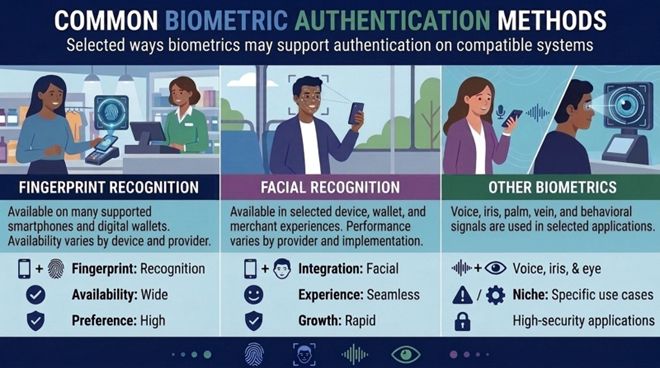
Common biometric authentication methods include:
- Fingerprint recognition: Available on many supported smartphones and digital wallets. Availability and adoption vary by device, provider, market, and user preference.
- Facial recognition: Available in some device, wallet, and merchant payment experiences. Availability and adoption vary by device, provider, market, and user preference.
- Other biometrics: Voice, iris, palm, vein, and behavioral signals are used in selected applications. Availability and performance depend on the provider, use case, operating environment, and implementation.
Where are biometrics used in payment-related experiences?
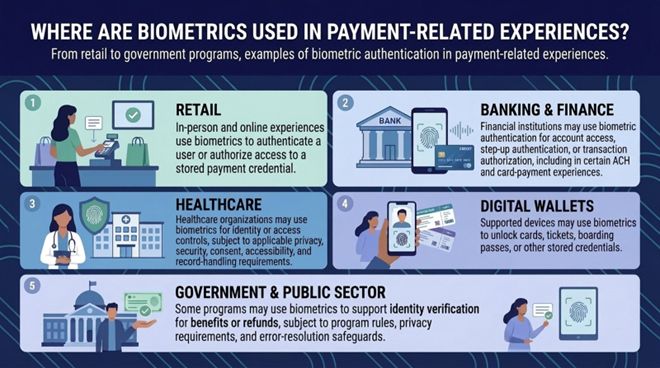
Biometrics may support payment authentication, identity verification, or access control. These functions are related but are not interchangeable. Examples may include:
- Retail: Some in-person and online experiences use biometrics to authenticate a user or authorize access to a stored payment credential.
- Banking and financial services: Some financial institutions and payment providers use biometric authentication for account access, step-up authentication, or transaction authorization. Availability and requirements vary by program and provider. In the European Union, a biometric can serve as the “inherence” element of strong customer authentication under PSD2.
- Healthcare: Some healthcare organizations may use biometrics for identity or access controls, subject to applicable privacy, security, consent, accessibility, and record-handling requirements.
- Digital wallets: Supported devices may use biometrics to unlock cards, tickets, boarding passes, or other stored credentials.
- Government and public-sector programs: Some programs may use biometrics to support identity verification for benefits or refunds, subject to program rules, privacy requirements, accessibility, and error-resolution safeguards.
Emerging trends in biometric payments
Some providers are exploring biometric authentication beyond fingerprint and facial recognition, including palm, vein, and behavioral signals. Many of these methods remain limited to specific providers, devices, markets, or pilot programs. Claims about broad adoption should therefore be supported by current, market-specific evidence.
Another area of development is multimodal authentication, which combines two or more authentication signals. This approach can add layers of authentication, but its effectiveness depends on enrollment, matching thresholds, spoof resistance, fallback methods, system design, and ongoing monitoring. For example, a higher-risk transaction might require a biometric signal plus a device credential or another form of step-up authentication.
Lessons from the field
From a merchant perspective, the first question should not be “Can we add biometric authentication?” but “What problem are we trying to solve?” A biometric step may improve convenience or provide an additional authentication signal, but its value depends on where it sits in the payment flow, which customers will use it, and whether it meaningfully improves security or the checkout experience.
Architecture matters just as much as the biometric itself. Merchants should understand whether biometric matching occurs on the customer’s device or whether biometric templates are processed or stored by a provider. That distinction can materially affect the merchant’s privacy, security, vendor-management, consent, retention, and deletion obligations.
Before committing to a deployment, merchants should also test the exception path. Customers may decline biometric authentication, be unable to use it, or experience a failed match. A reliable non-biometric checkout option should therefore be treated as part of the implementation, not as an afterthought.
Finally, merchants should evaluate biometrics like any other payment or fraud-control investment: define the expected outcome before launch and measure it. Checkout completion, authentication success and failure rates, fraud losses, support contacts, customer adoption, and fallback usage can help determine whether the technology is actually improving the payment experience.
* This discussion is illustrative and does not represent a currently available Cliq product or a commitment to offer biometric payment authentication.
Potential benefits for merchants
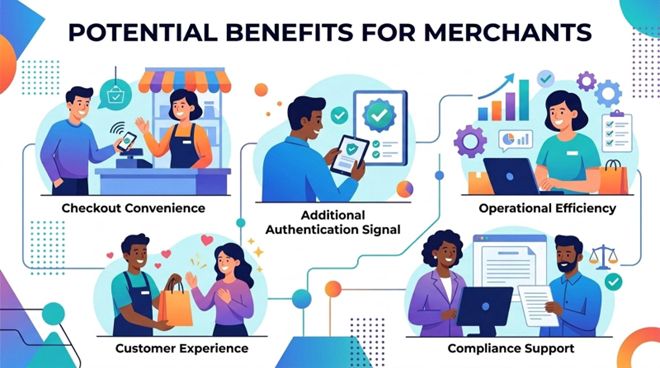
The potential benefits of biometric authentication depend on the provider, device, customer population, integration, transaction type, and operating environment:
- Checkout convenience: Biometrics may reduce the steps required to authenticate on supported devices. End-to-end transaction time still depends on connectivity, authorization, and other controls.
- Additional authentication signal: When appropriately implemented, biometrics can add a security layer, but they do not eliminate fraud, account takeover, chargebacks, or losses.
- Operational efficiency: Merchants may evaluate whether a specific implementation reduces verification or dispute-handling work in their environment.
- Customer experience: An optional, clearly explained biometric experience may be convenient for some users. Customer acceptance varies, and an accessible non-biometric alternative should be available.
- Compliance support: Biometrics may support an authentication control, but their use can also create notice, consent, security, retention, deletion, accessibility, and vendor-management obligations. Deployment does not establish regulatory compliance by itself.
Challenges and risk considerations
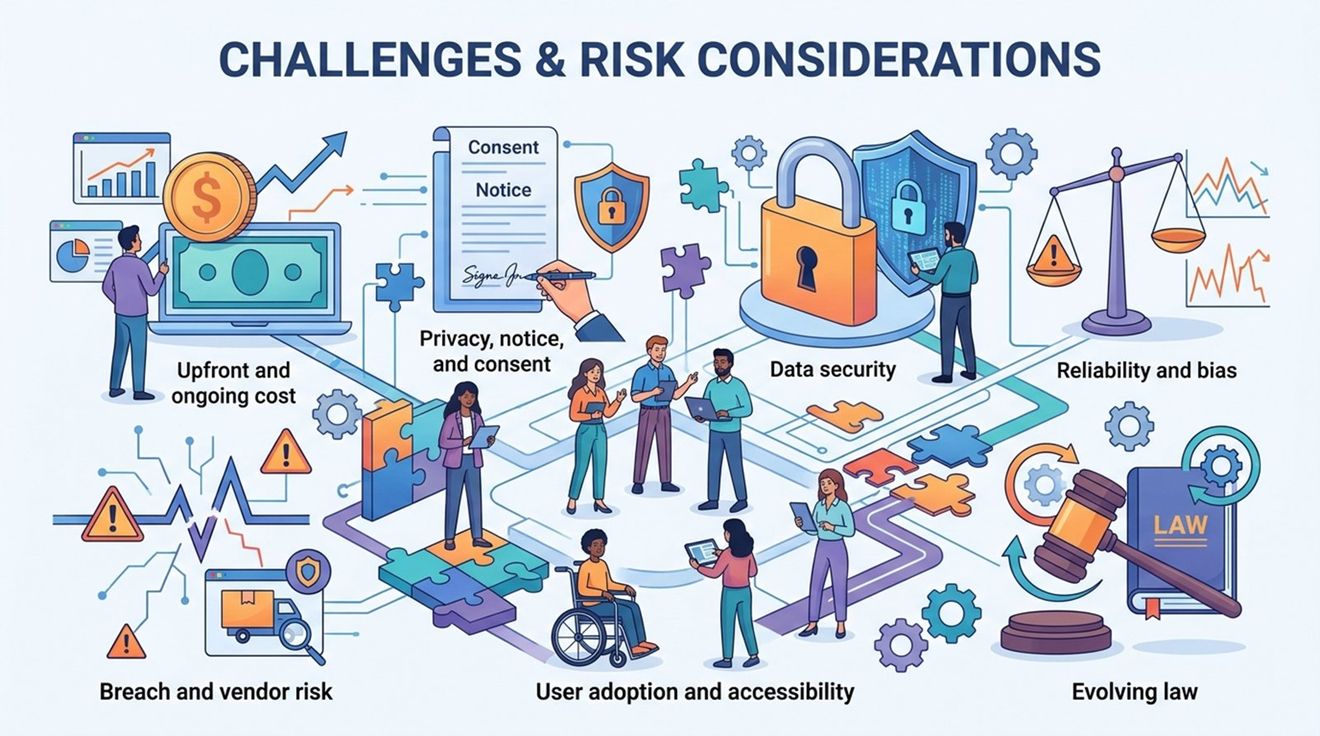
- Upfront and ongoing cost: Implementation may require hardware, software, integrations, vendor due diligence, testing, training, maintenance, and support.
- Privacy, notice, and consent: Depending on the jurisdiction, biometric-specific laws may impose requirements concerning written notice, consent, retention schedules, deletion, disclosure, and security. Requirements vary by jurisdiction and use case. Merchants should work with Legal and Compliance to assess notice, consent, purpose limitation, data minimization, consumer rights, vendor sharing, retention, deletion, and security obligations. Examples include the Illinois Biometric Information Privacy Act (BIPA), which requires written notice, a written release, and a public retention schedule and allows private lawsuits; Colorado’s biometric amendment to the Colorado Privacy Act (HB24-1130), effective July 1, 2025; biometric statutes in Texas and Washington; and the EU GDPR, which treats biometric data used to uniquely identify a person as a special category of personal data.
- Data security: Because biometric characteristics may be difficult to change after compromise, organizations should minimize collection and use risk-appropriate safeguards, which may include protected templates, encryption in transit and at rest where applicable, access controls, segregation, retention limits, vendor oversight, and incident-response planning.
- Reliability and bias: False matches, false rejections, demographic performance differences, device limitations, environmental conditions, and fallback processes can affect outcomes. Testing should reflect the intended population and operating environment. NIST’s Face Recognition Vendor Test study of demographic effects (NISTIR 8280) found that most of the face recognition algorithms it evaluated showed differences in accuracy across demographic groups, and that results depend heavily on the specific algorithm.
- Breach and vendor risk: A compromise or vendor failure can create legal, financial, operational, and reputational exposure. Contract terms, audit rights, incident-notification obligations, and data-handling practices should be reviewed before deployment.
- User adoption and accessibility: Some users may decline biometric authentication because of privacy, accessibility, religious, cultural, or personal considerations. Merchants should provide clear information, meaningful choices where required, and an accessible alternative.
- Evolving law: Biometric requirements continue to develop across jurisdictions. Organizations operating in multiple regions should maintain an inventory of biometric data flows and periodically reassess applicable requirements with Legal and Compliance. In the United States, the FTC’s May 2023 policy statement on biometric information signals that it may treat unsupported accuracy claims, or a failure to assess foreseeable risks before deployment, as unfair or deceptive practices under Section 5 of the FTC Act.
A practical evaluation checklist for merchants
Before committing to a biometric authentication provider or pilot, payment and compliance teams can use these questions to structure due diligence:
- Use case: Is the biometric used for payment authentication, identity verification, or access control? Each carries different requirements.
- Architecture: Does matching happen on the customer’s device or on the provider’s servers? Who stores templates, where, and for how long?
- Performance evidence: Can the vendor provide independent test results for false match and false non-match rates, spoof (presentation attack) resistance, and demographic performance?
- Legal mapping: Which biometric, privacy, and consumer protection laws apply in each market where customers will enroll?
- Consent and notice: How will customers receive notice, give consent where required, and withdraw it?
- Fallback and accessibility: What happens when a match fails or a customer declines? Is the alternative path tested and accessible?
- Vendor terms: Do contracts cover audit rights, breach notification timelines, data deletion on termination, and sub-processor use?
- Success metrics: Which metrics, such as checkout completion, step-up challenge rates, fraud losses, and support contacts, will decide whether the pilot scales?
What might the future of biometric payments look like?
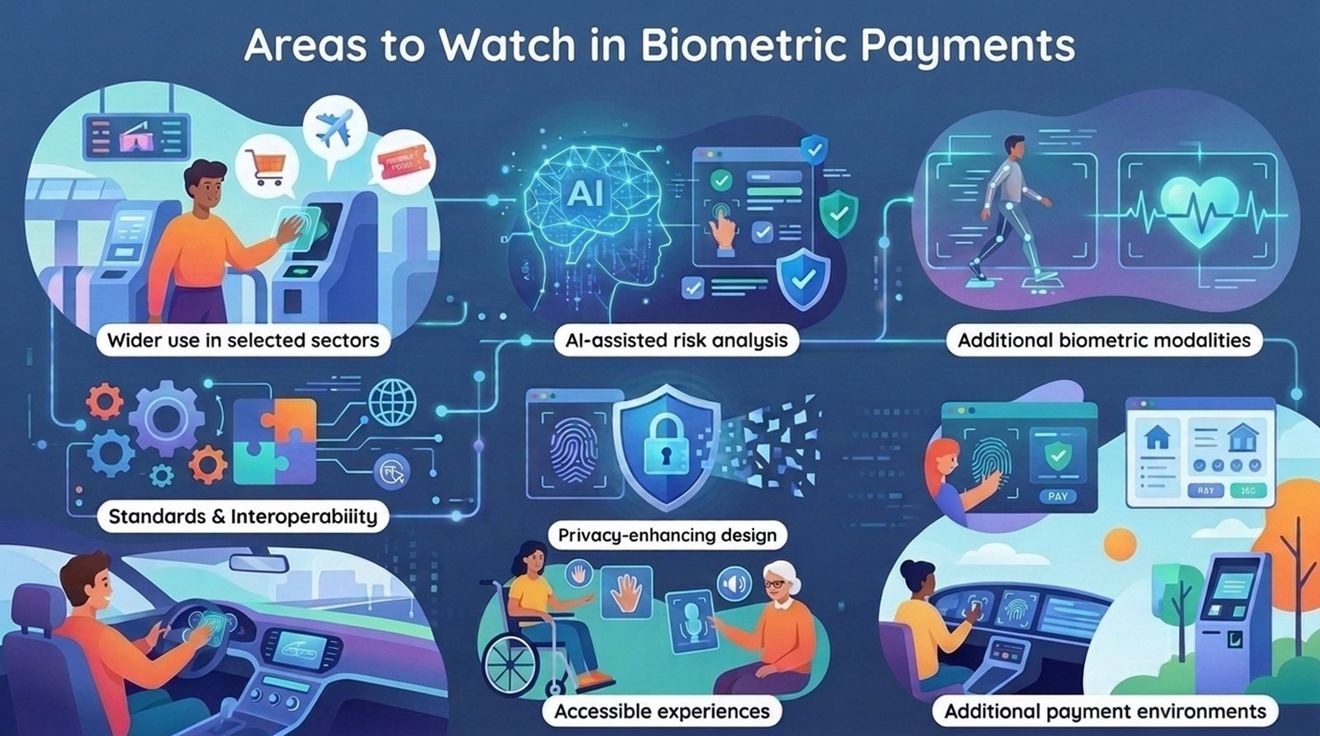
The future of biometric payments will depend on measurable security performance, consumer acceptance, privacy-preserving design, interoperability, cost, accessibility, and regulation. Areas that some providers, standards bodies, and researchers are exploring include:
- Wider use in selected sectors: Adoption may expand where providers can demonstrate reliable performance, lawful data practices, and a useful customer experience.
- AI-assisted risk analysis: AI may support pattern analysis and risk detection, but performance varies and requires testing for false positives, bias, model drift, and evasion, along with monitoring and human-governed controls.
- Additional biometric modalities: Future systems may explore palm, vein, heartbeat, gait, or other signals where technical performance and lawful use can be demonstrated.
- Standards and interoperability: Industry standards may continue to develop around testing, interoperability, privacy, security, and accessibility.
- Privacy-enhancing design: Future systems may make greater use of data minimization, protected templates, on-device matching, encryption, restricted retention, and stronger access controls.
- Accessible experiences: Design improvements may reduce barriers for users with disabilities or limited access to supported devices, while preserving reliable non-biometric alternatives.
- Additional payment environments: Biometric authentication may appear in selected peer-to-peer or digital-asset experiences, subject to provider support, risk controls, and applicable law.
Frequently asked questions about biometric payments
Are biometric payments safer than PINs or passwords?
They can be harder to steal or guess than a PIN or password, especially when matching happens on a secure device. They are not risk-free: spoofing, deepfakes, compromised devices, and weak fallback methods can still be exploited, which is why standards such as NIST SP 800-63B-4 pair biometrics with a physical authenticator.
Do merchants store customers’ fingerprints or face scans?
It depends on the system. With many smartphone wallets, the biometric match happens on the device and the merchant receives only a payment credential. Merchant-operated or provider-hosted systems, such as some palm or face payment programs, may store biometric templates with the provider, which brings additional legal and security obligations.
Which laws apply to biometric payments in the United States?
There is no single federal biometric privacy law. State laws such as Illinois BIPA, the Texas and Washington biometric statutes, and Colorado’s biometric amendment may apply, along with comprehensive state privacy laws and the FTC’s authority over unfair or deceptive practices. Requirements depend on where customers are located, so merchants should confirm applicability with counsel.
Should merchants offer a non-biometric option?
In most cases, yes. Some customers cannot or will not use biometrics because of disability, device access, religious or cultural reasons, or privacy concerns. A reliable alternative also protects checkout when a biometric match fails.
Will biometrics replace cards and passwords?
Not in the near term. Biometrics are most likely to keep growing as a convenient way to unlock existing credentials, such as cards in a digital wallet or passkeys, rather than as a replacement for the underlying payment credential.
The bottom line
Biometrics can make authentication more convenient and add a useful signal, but they are not a standalone solution for fraud prevention or compliance. Before launch, merchants should evaluate each deployment with Security, Privacy, Legal, Compliance, Accessibility, and Operations.
This article is for general information only and is not legal, compliance, or security advice. Laws and standards change; confirm current requirements with qualified advisers before deploying biometric authentication.
Sources
- NIST SP 800-63B-4, Digital Identity Guidelines: Authentication and Authenticator Management (July 2025): https://csrc.nist.gov/pubs/sp/800/63/b/4/final
- NISTIR 8280, Face Recognition Vendor Test Part 3: Demographic Effects (2019): https://www.nist.gov/publications/face-recognition-vendor-test-part-3-demographic-effects
- Federal Trade Commission, Policy Statement on Biometric Information and Section 5 of the FTC Act (May 2023): https://www.ftc.gov/system/files/ftc_gov/pdf/p225402biometricpolicystatement.pdf
- Illinois General Assembly, Biometric Information Privacy Act, 740 ILCS 14: https://www.ilga.gov/legislation/ilcs/ilcs3.asp?ActID=3004&ChapterID=57
- Colorado General Assembly, HB24-1130, Privacy of Biometric Identifiers & Data: https://leg.colorado.gov/bills/HB24-1130
- European Union, General Data Protection Regulation (EU) 2016/679, Article 9: https://eur-lex.europa.eu/eli/reg/2016/679/oj
So, what's next?
We're ready to get started.