
Introduction
Chargebacks are more than an occasional inconvenience. They raise operating costs, reduce revenue, create administrative work, and — if dispute rates climb too high — can put a merchant account at risk. Many of them, though, are preventable.
Payment networks such as Visa call these cases disputes, because they begin when a cardholder questions a transaction with their card issuer. Knowing why disputes happen, and how to prevent and respond to them, is one of the most effective ways for a merchant to protect revenue. This guide covers how to reduce chargebacks by preventing disputes, responding effectively when they occur, and running a long-term dispute management process.
How Can Merchants Reduce Chargebacks?
Merchants can reduce chargebacks by:
- Recognizable billing descriptors
- Proper transaction authorization
- Fraud tools: AVS, CVV2, 3‑D Secure
- Clear customer expectations
- Fast responses to customer questions
- Complete transaction records
- Dispute trend monitoring
- Compelling evidence for invalid disputes
Eight practices that reduce chargebacks — each is covered in detail below.
The most effective programs treat chargeback prevention as an ongoing process, not a one-time fix.
Understanding Chargebacks (Disputes)
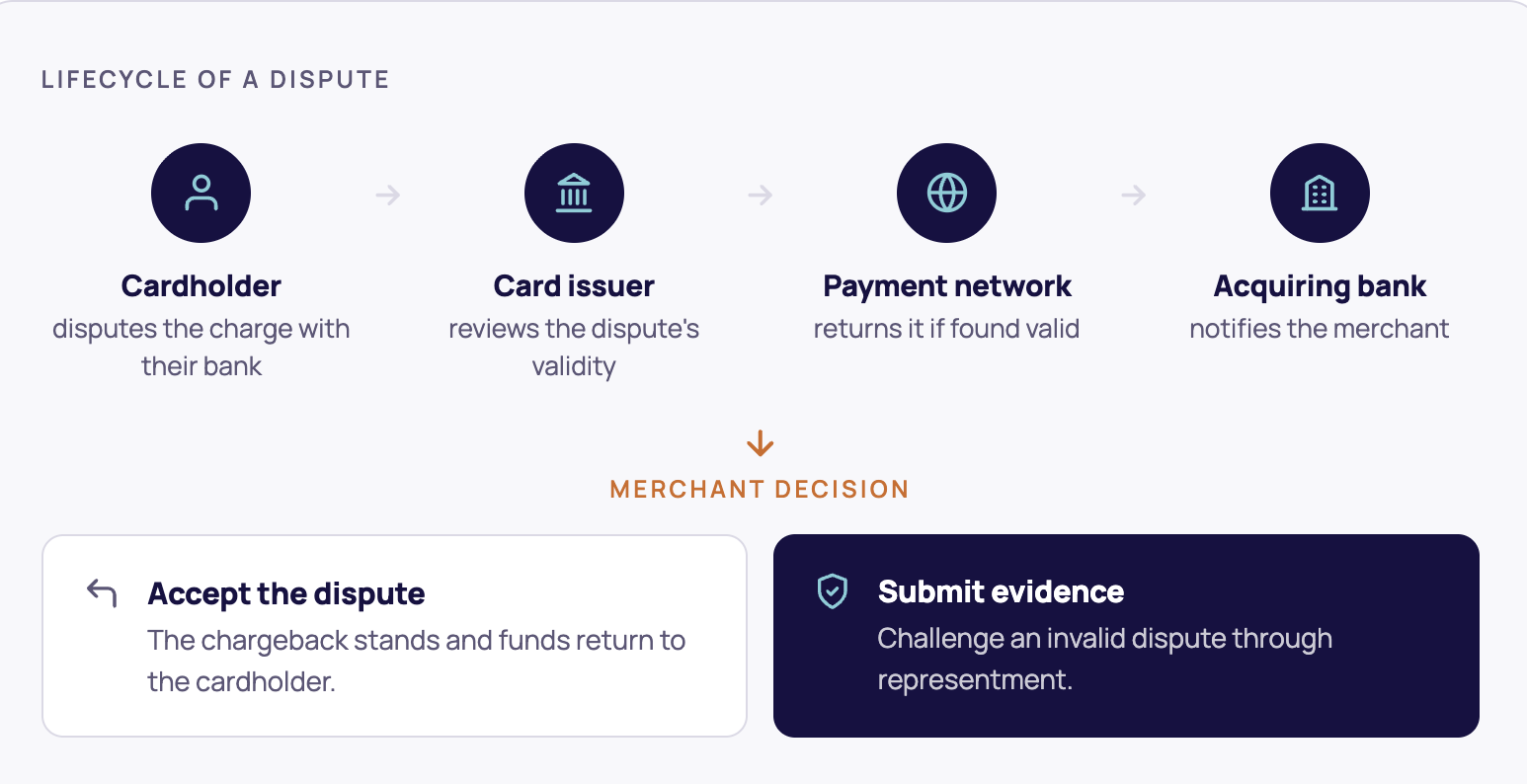
A chargeback begins when a cardholder disputes a transaction with their card issuer. If the issuer finds the dispute valid, it is returned through the payment network to the merchant's acquiring bank, where the merchant can accept it or submit evidence supporting the original transaction.
The Four Types of Chargebacks
Visa organizes disputes into four categories, each calling for a different prevention approach. Identifying the reason behind a dispute points to the operational fix instead of treating every chargeback the same way.
| Dispute Category | Common Examples |
|---|---|
| Fraud | Stolen cards, unauthorized transactions |
| Authorization | Missing or declined authorization |
| Processing errors | Duplicate charges, incorrect amounts, invalid transaction data |
| Consumer disputes | Merchandise not received, cancelled subscriptions, defective products |
Why Chargebacks Happen
Fraud draws the most attention, but many disputes come from preventable operational issues. Common causes:
- Fraud: Unauthorized purchases made with stolen payment credentials.
- Friendly fraud: Legitimate customers dispute valid purchases they don't recognize, forgot making, or misunderstand.
- Merchant errors: Duplicate billing, processing mistakes, shipping delays, unclear policies, or poor communication.

A Four-step Framework for Reducing Chargebacks
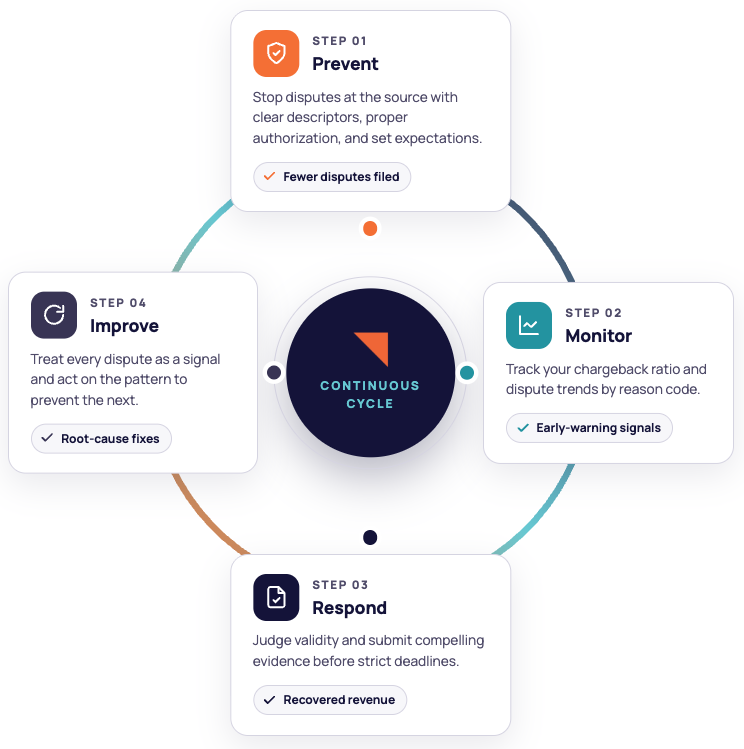
Rather than reacting to chargebacks one at a time, effective merchants run an ongoing process.
Step 1: Prevent Disputes Before They Happen
Use recognizable billing descriptors. Customers should recognize the business name on their statement; the descriptor should include the DBA name and, where supported, customer service contact details. Visa recommends confirming that customers can identify the business.
Obtain proper authorization. Merchants should never process after a declined authorization, should process chip cards correctly, and should avoid keying transactions unless necessary. Improper authorization is a leading cause of avoidable disputes.
Use fraud detection and fraud management tools. AVS, CVV2, Visa Secure (3‑D Secure), device fingerprinting, and risk scoring help flag suspicious transactions before approval.
Set clear customer expectations. Many consumer disputes come from confusion. Merchants should state shipping timelines, return and cancellation policies, subscription renewals, and product details clearly; Visa recommends disclosing refund and cancellation terms before purchase.
Provide responsive customer service. Making it easy for customers to reach the business first — by phone, email, or chat — resolves many issues before they escalate to the bank.
Step 2: Monitor Chargeback Activity
Reducing chargebacks also means measuring. Merchants should track:
- Chargeback ratio
- Disputes by reason code
- Fraud vs. consumer disputes
- Card-present vs. card-not-present
- Initial vs. successfully resolved
The metrics that surface recurring problems before they grow.
Step 3: Respond Quickly to Disputes
When a dispute arrives, a merchant should review the reason, judge whether it is valid, gather documentation, submit evidence before the deadline, and track the outcome. Timelines are strictly enforced.
Understanding representment. Representment is the process of challenging an invalid chargeback with evidence that the transaction was legitimate. Strong responses combine several forms of proof:
- Delivery confirmation
- Customer communications
- AVS results
- Visa Secure authentication
- Device IDs and IP addresses
- Login history
- Prior undisputed transactions
- Signed recurring-billing agreements
- Terms and conditions accepted at checkout
Evidence that strengthens a representment case.
Step 4: Improve the Process
Every dispute is a signal. For each one, a merchant can ask whether fraud was involved, whether communication or fulfillment fell short, whether a refund lagged, whether a processing error occurred, or whether staff need training. Acting on the pattern reduces future disputes.
Chargeback Prevention Checklist
- Use recognizable billing descriptors
- Obtain proper authorization
- Process chip transactions correctly
- Use AVS, CVV2, and Visa Secure where appropriate
- Clearly disclose refund and cancellation policies
- Send order confirmations and shipping updates
- Respond promptly to customer inquiries
- Process refunds quickly when appropriate
- Maintain complete transaction documentation
- Monitor dispute trends and reason codes
- Ensure customers accept the terms and conditions at checkout
How Cliq Supports Chargeback Management
Cliq offers chargeback and dispute management as an integrated set of tools and services. In plain terms, the components are:
- Payer Authentication (3‑D Secure)
For card-not-present orders. When a transaction is authenticated, network rules can shift liability for certain unauthorized-transaction fraud claims from the merchant to the card issuer. - Decision Manager
AI fraud screening powered by Visa Acceptance Solutions, with rules that can be tuned to a merchant's risk profile. - Order Insight
Shares transaction and order data with card issuers to help resolve disputes early. - Proactive Chargeback Prevention
Dispute alerts through Verifi CDRN, Visa RDR, and Ethoca that notify a merchant of disputes so they can be addressed directly. - Expert-Led Chargeback Remediation
U.S.-based specialists assemble evidence packages for contested disputes (representment). - Automated Dispute Resolution
Automated evidence collection and submission to help merchants meet response deadlines. - Chargeback-ratio and Monitoring Metrics
Visibility into dispute trends and network-monitoring metrics from Cliq's chargeback product dashboards.
Important. Cliq provides chargeback management tools, monitoring, and support services designed to assist merchants in managing disputes and chargeback activity. Cliq does not guarantee the prevention of chargebacks, recovery of funds, avoidance of fees, or compliance with card-network monitoring programs. Any performance figures are based on internal data for certain merchants and dispute types and may not be representative; actual outcomes vary by business model, transaction volume, reason codes, customer behavior, card-network rules, and implementation. References to Visa, Verifi, Ethoca, CyberSource, CDRN, and RDR are for informational purposes only.
Frequently Asked Questions
What is a good chargeback ratio?
Payment networks and processors monitor dispute activity using different thresholds and programs. Rather than fixating on one percentage, merchants should watch dispute trends and work to reduce preventable disputes.
Can chargebacks be reversed?
Yes. If a dispute is invalid, a merchant may submit supporting documentation through representment. Success depends on the quality of the evidence and the specific dispute reason.
What causes the most chargebacks?
Fraud, friendly fraud, processing errors, subscription misunderstandings, shipping issues, and merchandise or services that fall short of expectations.
Should every chargeback be disputed?
No. Merchants should assess whether a dispute is valid first. Valid customer disputes are often resolved faster through prompt refunds, while invalid ones may warrant a formal, evidence-backed response.
What's the difference between a refund and a chargeback?
A refund is initiated voluntarily by the merchant. A chargeback is initiated by the cardholder through their issuing bank and typically involves additional fees, documentation, and network review.
Conclusion
Reducing chargebacks is less about winning every dispute than about preventing avoidable ones. Secure payment practices, clear communication, ongoing monitoring, and timely, well-evidenced responses protect revenue while improving the customer experience. The strongest programs run a continuous cycle — prevent, monitor, respond, improve.
Primary sources: Visa's Dispute Management Guidelines for Visa Merchants and the Visa Core Rules and Visa Product and Service Rules (Visa.com). This article is a plain-language summary; the Visa rules and the merchant agreement govern.
So, what's next?
We're ready to get started.