
This guide explains how the core pieces of card acceptance fit together. Technical definitions are written to reflect current, authoritative sources — including the PCI Security Standards Council, EMVCo, and the Federal Reserve — which are listed under References. Terms defined here link to the Payments Glossary for deeper detail.
Introduction
Businesses researching how to accept payments run into the same three terms again and again: payment gateway, payment processor, and merchant account. They're closely connected, they often come bundled in a single product, and they're routinely used as if they mean the same thing. They don't.
Here's the short answer. A payment gateway securely captures and transmits payment information. A payment processor facilitates the communication that moves a transaction among the parties in the payment ecosystem. A merchant account is an acquiring arrangement that enables a business to accept card payments and receive the resulting proceeds. Each function plays a distinct role in card acceptance, although the way those functions are delivered varies by provider and acquiring arrangement.
The reason the distinction feels blurry is that modern payment infrastructure providers may combine or connect several of these functions through a single platform. So while the functions remain separate, the products that deliver them increasingly don't. This guide defines each component, shows how a card payment flows through them, and explains how the traditional model compares with today's more integrated infrastructure — so you can evaluate a provider on capabilities and architecture rather than labels.
The Payment Stack in 30 Seconds
If you only need the map, this is it: each question below points to the part of the stack that answers it.
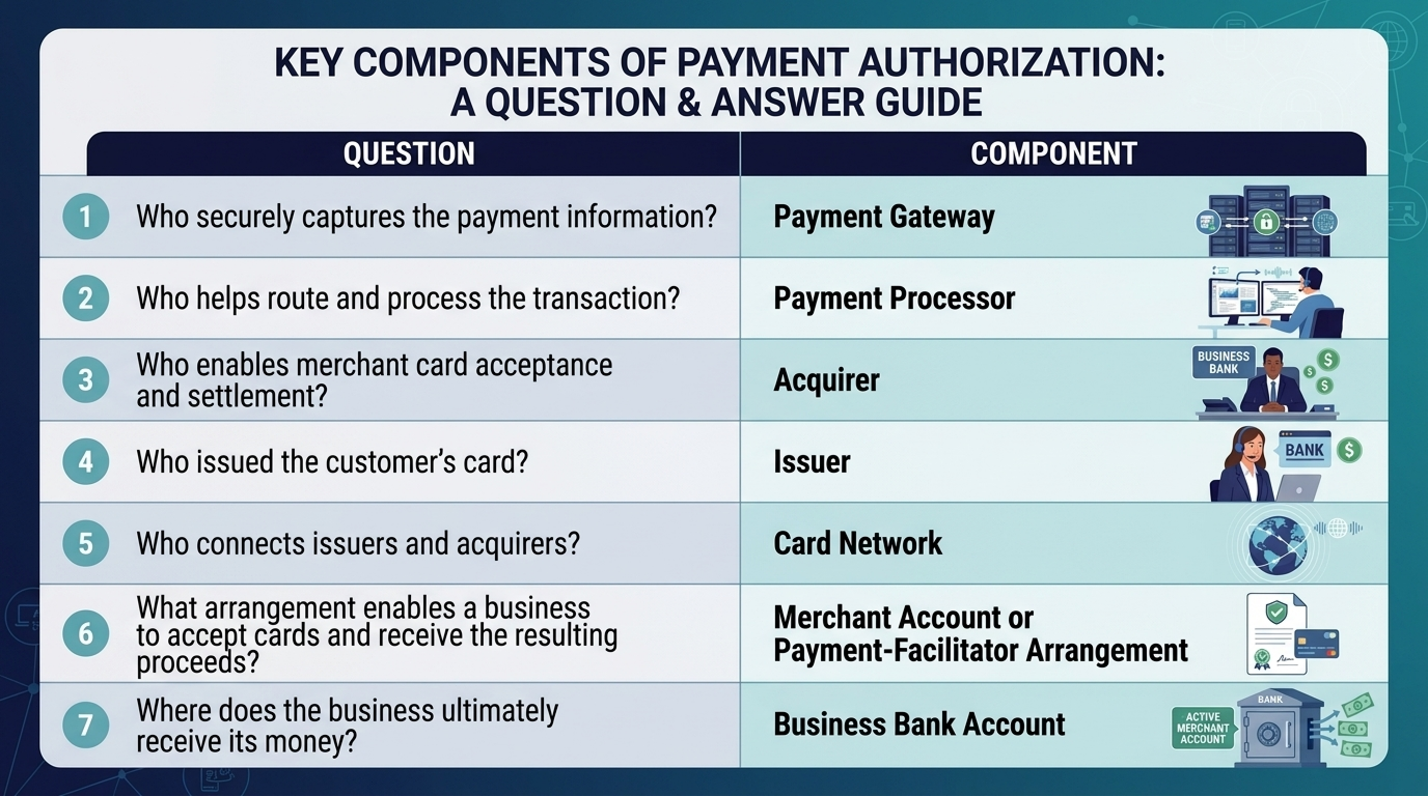
Payment Gateway vs. Processor vs. Merchant Account at a Glance
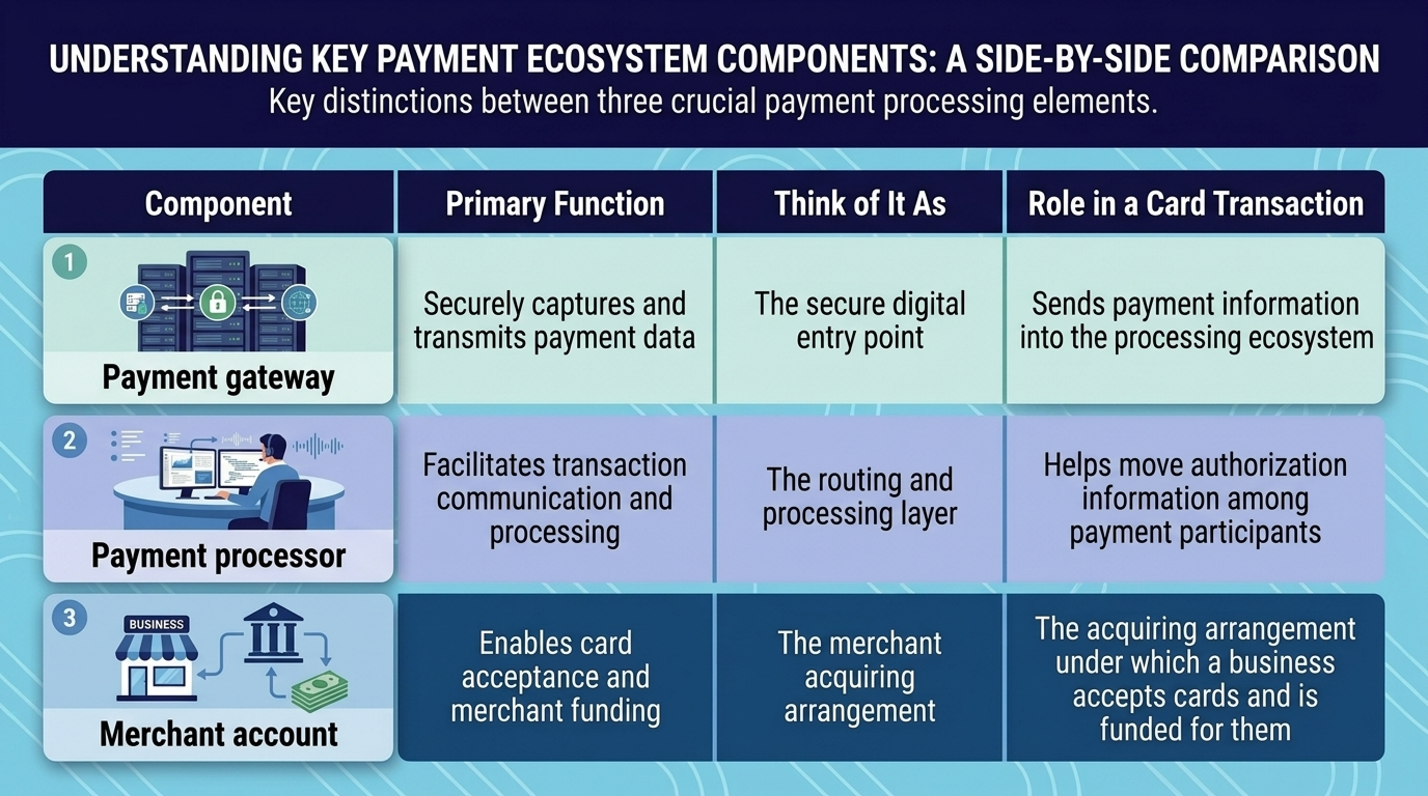
The exact architecture varies by payment provider, acquiring arrangement, payment method, and business model. Treat the table as a mental model, not a wiring diagram — in practice, one provider may perform several of these roles, and some are handled through partners.
What Is a Payment Gateway?
Payment Gateway Definition
A payment gateway is technology that securely captures payment information and transmits it to the systems responsible for authorizing and processing the transaction. It's the secure entry point where a payment begins.
Payment gateways are especially common in e-commerce, in-app payments, payment links, recurring billing, virtual terminals, and other card-not-present environments. Gateway technology may also support integrated in-person payment architectures, depending on the provider. In each case, the gateway's job is to take payment data safely and hand it off to the rest of the stack.
What Does a Payment Gateway Do?
In a typical card payment, the gateway:
- Captures the customer's payment information at checkout.
- Protects payment information in transit through encryption and may replace sensitive card data with tokens where tokenization is implemented.
- Sends the transaction for authorization.
- Receives the authorization response.
- Communicates the approval or declines back to the checkout.
Two security concepts do a lot of the work here. Encryption protects data as it moves, and tokenization replaces sensitive card data with a non-sensitive token so the real number is exposed as little as possible — the PCI Security Standards Council and EMVCo's payment tokenisation framework treat the two as distinct safeguards. Both are defined in the Payments Glossary.
Related: Payment Processor, Authorization, Tokenization, PCI DSS
What Is a Payment Processor?
Payment Processor Definition
A payment processor provides the technology and services that help route transaction information among merchants, acquiring institutions, payment networks, and issuing banks, so a payment can be authorized, cleared, and settled.
The exact responsibilities of a processor vary by payment arrangement. Some processors focus narrowly on routing and authorization; others coordinate clearing and settlement support and provide reporting on top. This is a nuance many generic explanations skip — "processor" describes a role in the flow, not a fixed, identical product from vendor to vendor.
What Does a Payment Processor Do?
Across most arrangements, a processor helps with:
- Transaction routing — directing each transaction along the right path to the right participants.
- Authorization of communication — carrying the approve-or-decline request and response.
- Clearing — exchanging transaction details so obligations between institutions can be worked out.
- Settlement support — coordinating the movement of funds between institutions.
- Ecosystem connections — linking the merchant's environment to acquirers, networks, and issuers.
- Transaction reporting — returning the data a business needs to reconcile and account for its payments.
Several of these terms — authorization, clearing, and settlement — have their own glossary entries, because the distinctions between them matter more than they first appear.
Related: Payment Gateway, Acquirer, Authorization, Clearing, Settlement
What Is a Merchant Account?
Merchant Account Definition
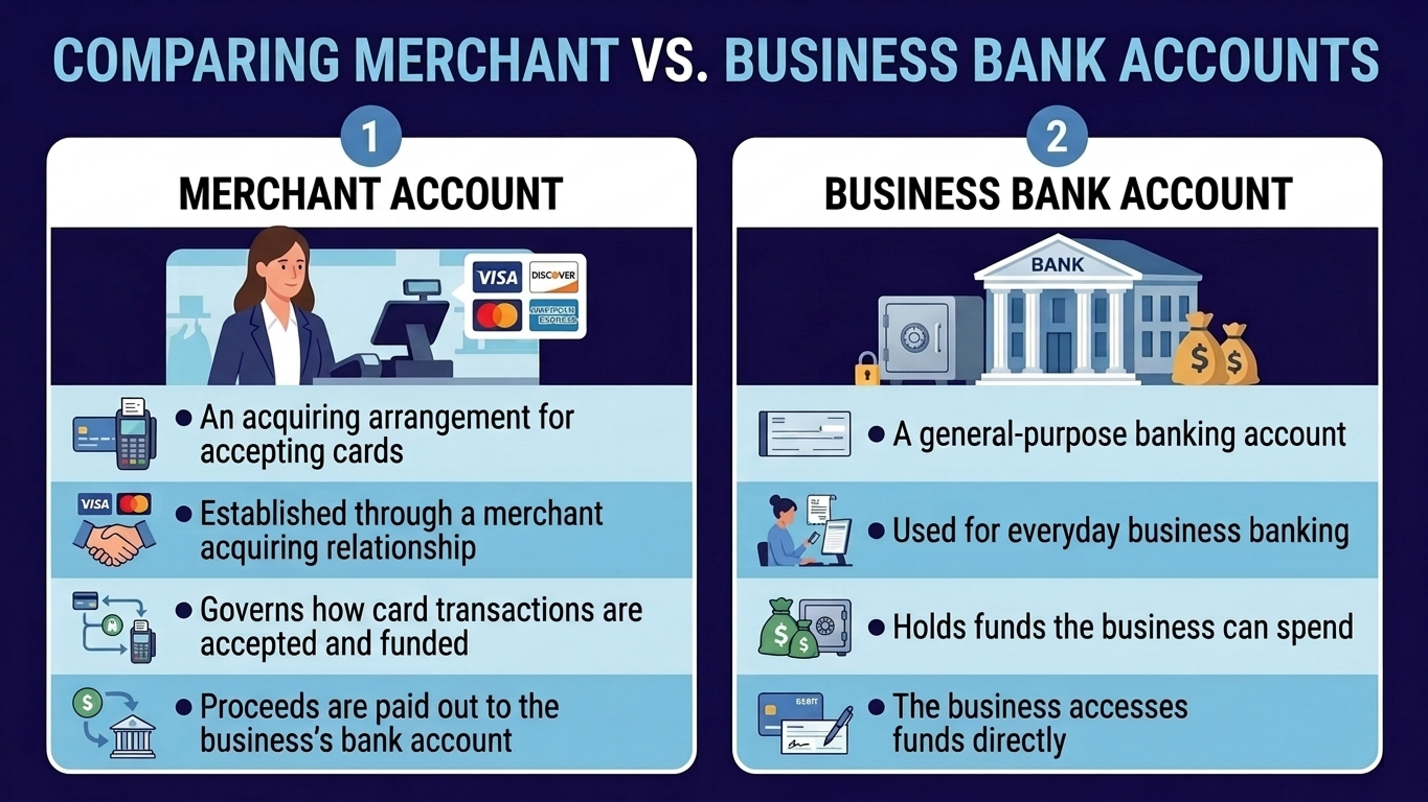
A merchant account is an acquiring arrangement that allows a business to accept card payments and receive the resulting proceeds, subject to underwriting, processing terms, reserves, adjustments, and other risk controls. A business may have a direct merchant account or receive access through a payment facilitator or bundled provider.
A merchant account is not a general-purpose business bank account. It establishes the commercial and risk framework under which card transactions are accepted, funded, refunded, and adjusted. The resulting proceeds are generally paid to the business's designated bank account according to its provider's funding schedule.
Related: Acquirer, Payment Processor, Settlement, Payment Facilitator
Merchant Account vs. Business Bank Account
How Does a Card Payment Actually Work?
The three components make the most sense once you watch a payment move through them.
Card Payment Authorization — Step by Step
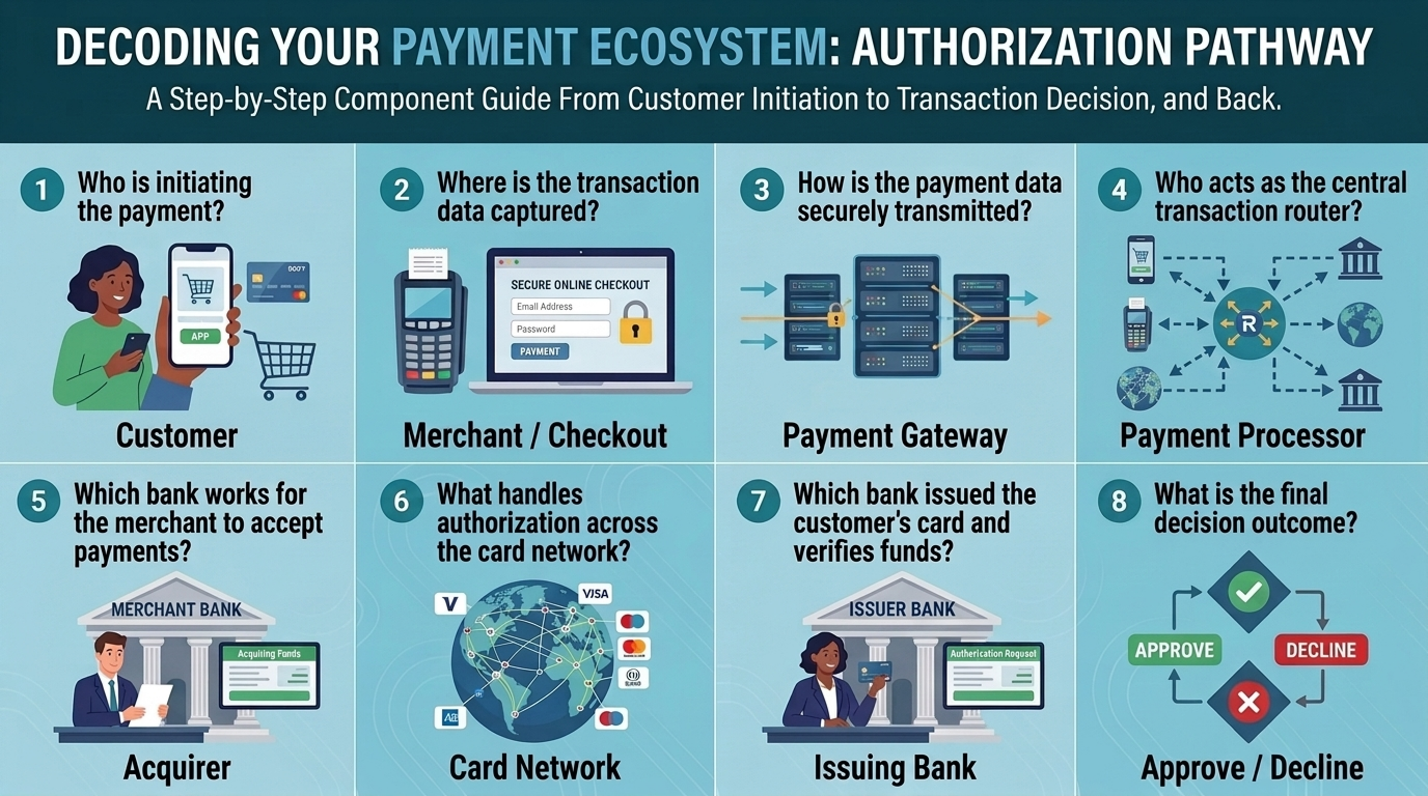
Reading the flow from the top:
- The customer starts a payment at checkout.
- The merchant's checkout hands the payment data to the gateway.
- The payment gateway securely captures the data and sends it on for authorization.
- The payment processor routes the authorization request toward the acquirer and network.
- The acquirer submits the request into the card network on the merchant's behalf.
- The card network carries the request to the right issuer.
- The issuing bank decides whether to approve or decline, based on the account.
- The response travels back along the same path — network, acquirer, processor, gateway — to the checkout, where the customer sees an approval or decline.
Authorization is only the first act. Approval indicates that the issuer has approved the transaction at that stage; it does not move the funds or guarantee that the transaction will be captured, settled, or funded. Clearing and settlement come afterward, which is why the money doesn't arrive the instant a payment is approved.
Where Do the Acquirer, Issuer, and Card Network Fit?
Three more participants sit around the gateway, processor, and merchant account. Naming them makes the rest of the flow click into place.
Acquirer
An acquirer is the financial institution or acquiring entity that enables a merchant to accept card payments and participates in processing and settling those transactions. It's the merchant's side of the banking relationship.
Related: Issuer, Card Network, Merchant Account, Settlement
Issuer
An issuer is the financial institution that provides the customer's payment card and decides whether a given transaction should be approved or declined. It's the customer's side of the banking relationship.
Related: Acquirer, Card Network, Authorization
Card Network
A card network — such as Visa, Mastercard, American Express, or Discover — connects acquirers and issuers, carries the messages between them, and sets the operating rules and standards that both sides follow — published in each network's operating rules.
Put together, the relationship reads in one line:

The acquirer represents the merchant, the issuer represents the customer, and the card network is the connective tissue between them.
Authorization vs. Clearing vs. Settlement
These three words are often used loosely, but they describe distinct steps — and the difference is the single most common source of "where's my money?" confusion.
Authorization
Authorization determines whether a transaction can proceed. It answers one question — can this transaction be approved? — by checking the account with the issuer. It commonly places a hold on the amount, though it doesn't move any money or guarantee the transaction will be captured and settled.
Clearing
In clearing, transaction information is exchanged between the participating institutions and the financial obligations between them are calculated. This is where the system works out exactly who owes what.
Settlement
In settlement, participating financial institutions discharge the obligations created by cleared transactions. The exact settlement arrangements vary by card network, acquirer, processor, and financial institution. Merchant funding then occurs according to the provider's payout schedule, so an approved sale may not appear in the business's designated bank account immediately.
Approved doesn't mean deposited. Authorization indicates that the issuer has approved the transaction at that stage; clearing, settlement, and merchant funding determine how the transaction is finalized and when the proceeds reach the business.
How the Traditional Payment Stack Fits Together
In the traditional model, the components line up as a chain:
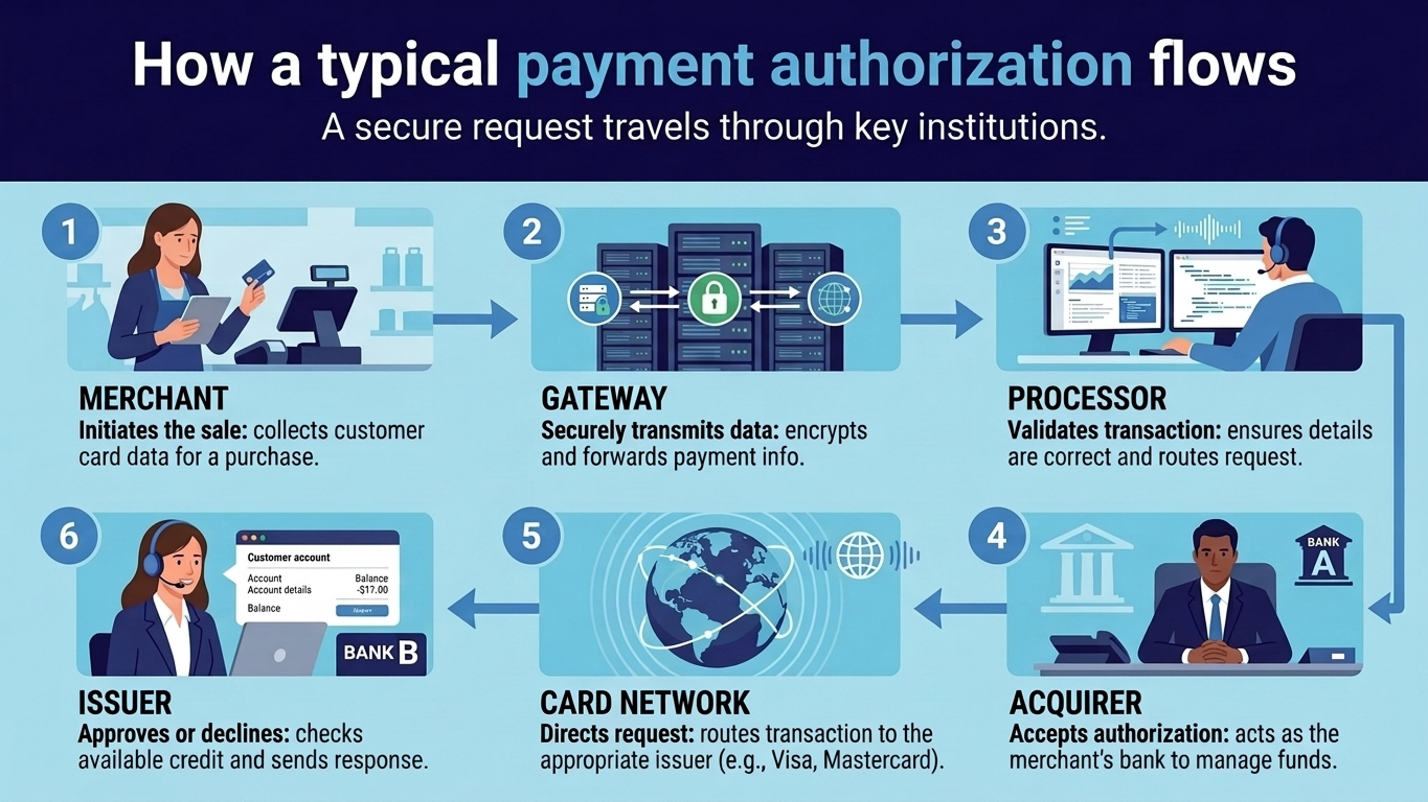
Historically, a business might have held separate relationships with different companies for different parts of this chain: one for the gateway, another for processing, another for the acquiring relationship and merchant account. Each piece was contracted, integrated, and reconciled on its own. That model still exists, and for some businesses it's the right one — but it's no longer the only option.
How Modern Payment Infrastructure Brings These Components Together
Today, businesses may use payment infrastructure platforms that provide or connect multiple capabilities through a single technology layer. Payment infrastructure platforms provide or connect multiple capabilities through a single technology layer — often including:
- Payment acceptance
- APIs and integrations
- Payment routing
- Merchant acquiring connections
- Support for multiple payment methods
- Tokenization
- Fraud and risk management
- Authentication
- Settlement
- Reconciliation and reporting
One distinction is worth stating precisely. A payment infrastructure provider isn't a replacement for every participant in the payment ecosystem — acquirers, networks, and issuers still play their roles. What it does is provide the technology and connections that let a business reach and manage those parts through one unified layer, instead of stitching them together itself. That's the shift this guide keeps returning to: from assembling vendors to building on infrastructure.
Do Businesses Still Need a Gateway, Processor, and Merchant Account?
The functions still exist, so in that sense the answer is yes. But you don't necessarily need three separate providers to get them. Modern payment providers may bundle or integrate these capabilities, so the practical question shifts from "how many vendors do I sign up with?" to "what does one provider actually deliver, and how?"
When evaluating a provider, it helps to ask:
- Which functions does the provider perform directly, and which run through partners?
- Which payment methods are supported?
- Who handles the acquiring relationship?
- How, and how quickly, are funds settled and paid out?
- Which APIs and integrations are available?
- How are fraud and security managed?
Those questions tell you far more than whether a product is labeled a "gateway" or a "processor."
Payment Gateway vs. Payment Processor: What's the Difference?
In a payment gateway vs payment processor comparison, the difference comes down to capture versus routing. A payment gateway primarily captures and securely transmits payment information, while a payment processor helps route and process that transaction information among the institutions and networks required to authorize and settle a payment. Some modern payment platforms provide both capabilities within one integrated solution.
In practice: when a customer enters card details at checkout, the gateway is what safely takes and transmits those details. The processor is what then carries the transaction through the network to the issuer for a decision and coordinates the steps that follow. One is the secure front door; the other is the routing behind it.
Payment Processor vs. Merchant Account: What's the Difference?
A payment processor facilitates transaction processing and communication, while a merchant account is the acquiring arrangement that enables a business to accept cards and be funded for the resulting transactions. The processor moves the transaction; the merchant account is the arrangement through which the business is funded. You can read fuller definitions of the payment processor and merchant account in the glossary.
What Should Businesses Look for in Payment Infrastructure?
Once the labels stop doing the work, the useful comparison is capability by capability.
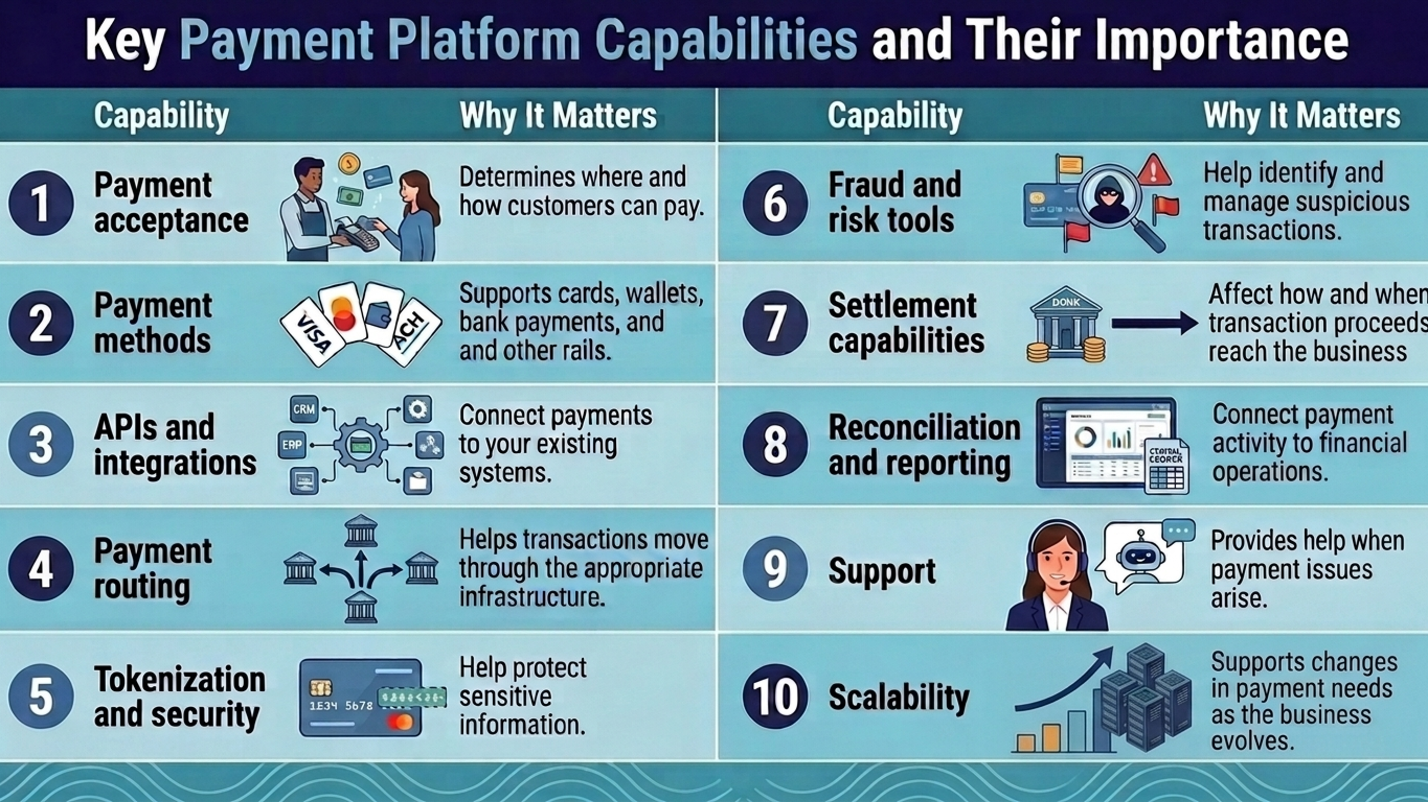
This is where Cliq fits — as payment infrastructure: the technology and connections that let a business access and manage several parts of the payment stack through one platform, rather than a single feature bolted onto the rest.
Frequently Asked Questions
What is the difference between a payment gateway and payment processor?
A payment gateway captures and securely transmits payment information, while a payment processor routes and processes that information among the institutions and networks needed to authorize and settle a payment. Some platforms provide both in one integrated solution.
What is a merchant account?
A merchant account is an acquiring arrangement that lets a business accept card payments and receive the resulting proceeds, subject to underwriting, processing terms, reserves, and other risk controls. A business may have a direct merchant account or receive access through a payment facilitator or bundled provider.
Do I need a payment gateway and payment processor?
Online card acceptance requires payment-capture and processing functions, but those capabilities do not have to come from separate providers. Many modern platforms provide gateway and processing capabilities together.
Do I need a merchant account to accept credit cards?
A business needs access to a merchant acquiring relationship to receive card proceeds, but that access can come through a direct merchant account or through a provider or payment facilitator that supplies it. You won't always open a standalone merchant account yourself.
Can one company provide payment processing and gateway services?
Yes. Many payment platforms provide both, and often more of the stack, through a single integrated product and API.
Is a payment processor the same as an acquirer?
No. A processor provides the technology and services that route and process transactions, while an acquirer is the financial institution that enables merchant card acceptance and participates in settlement. One provider may deliver both, but the roles are distinct.
Where does a payment gateway fit in the payment process?
The gateway sits at the start, at the point of capture. It securely takes the payment information at checkout and transmits it into the processing ecosystem for authorization.
What happens after a card payment is authorized?
Authorization indicates that the issuer has approved the transaction at that stage, but it does not move the funds. Clearing exchanges transaction details and calculates obligations between institutions, settlement discharges those obligations, and the business is then funded according to its provider's schedule.
How does payment settlement work?
In settlement, funds move between the participating financial institutions as transactions are finalized. The business then receives its proceeds through its merchant acquiring arrangement and funding schedule, which is usually a separate step from interbank settlement.
What is payment infrastructure?
Payment infrastructure is the combined technology and connections that let a business accept, process, secure, settle, and reconcile payments. Modern infrastructure platforms bring several of these capabilities together through one unified layer rather than requiring a business to assemble each part separately.
Conclusion
The three-part distinction is worth holding onto. A payment gateway securely captures and transmits payment information. A payment processor facilitates transaction processing and communication. A merchant account is the acquiring arrangement that enables a business to accept cards and receive the resulting proceeds.
Those functions remain fundamental to card payments. Businesses can also reach these functions through integrated payment infrastructure rather than assembling each component separately. Understanding the underlying stack is what lets you evaluate providers on capabilities, architecture, security, integrations, and scalability — not simply on labels.
Call to Action
When you evaluate a payment provider, look at the whole stack, not a single feature: how customers can pay, how payments integrate with your systems, how transactions are routed and secured, how funds settle and report, and what support stands behind it. That's the lens payment infrastructure is built for — explore how Cliq can provide the infrastructure for acceptance, integration, processing, and reporting.
Payment Infrastructure: The Entity Map
Underneath the comparison, this guide describes a single system. The map below shows how the pieces relate — each links to its Payments Glossary entry for a deeper definition.
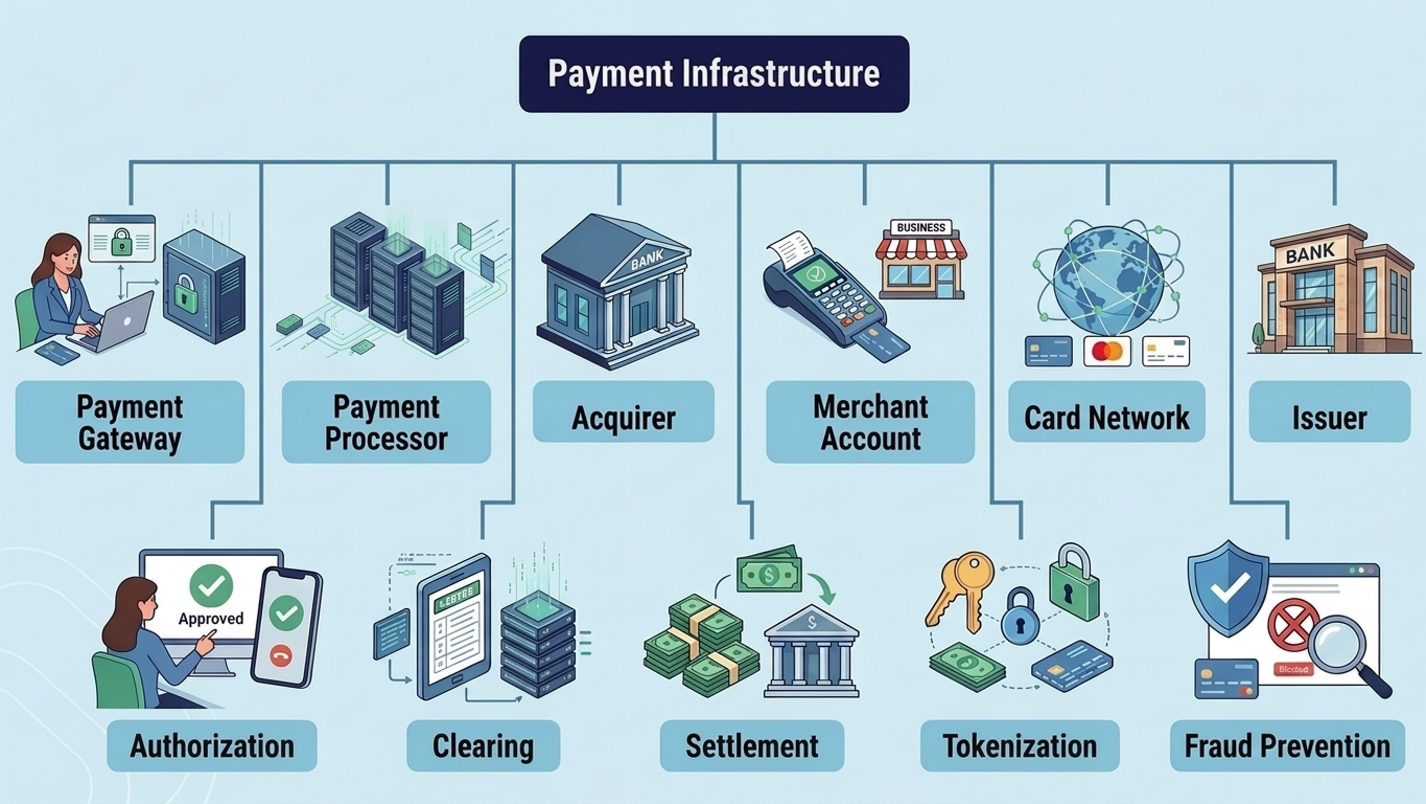
- Payment infrastructure — the technology and connections that tie the rest together.
- Payment gateway — captures and transmits payment data.
- Payment processor — routes and processes the transaction.
- Acquirer — enables merchant acceptance and participates in settlement.
- Merchant account — the acquiring arrangement that enables card acceptance and funding.
- Card network — connects acquirers and issuers and sets the rules.
- Issuer — provides the card and approves or declines.
- Authorization — decides whether a transaction can proceed.
- Clearing — exchanges details and calculates obligations.
- Settlement — moves funds between institutions.
- Tokenization — replaces sensitive card data with a non-sensitive token.
- Fraud prevention — identifies and manages suspicious activity.
References
All sources retrieved August 1, 2026.
- PCI Security Standards Council (PCI SSC) — Glossary of Terms, Abbreviations, and Acronyms (defines acquirer, payment processor, and token/tokenization) and the PCI DSS Tokenization Guidelines.
- EMVCo — EMV Payment Tokenisation Specification.
- Visa — Glossary: authorization, clearing, and settlement (the transaction-flow stages, on Visa's own developer site).
- Federal Reserve Financial Services — National Settlement Service and the Fedwire Funds Service.
- Card-network operating rules — Visa Core Rules and Visa Product and Service Rules and the Mastercard Rules. Confirm current rules with the applicable network and your acquirer.
So, what's next?
We're ready to get started.