
Introduction
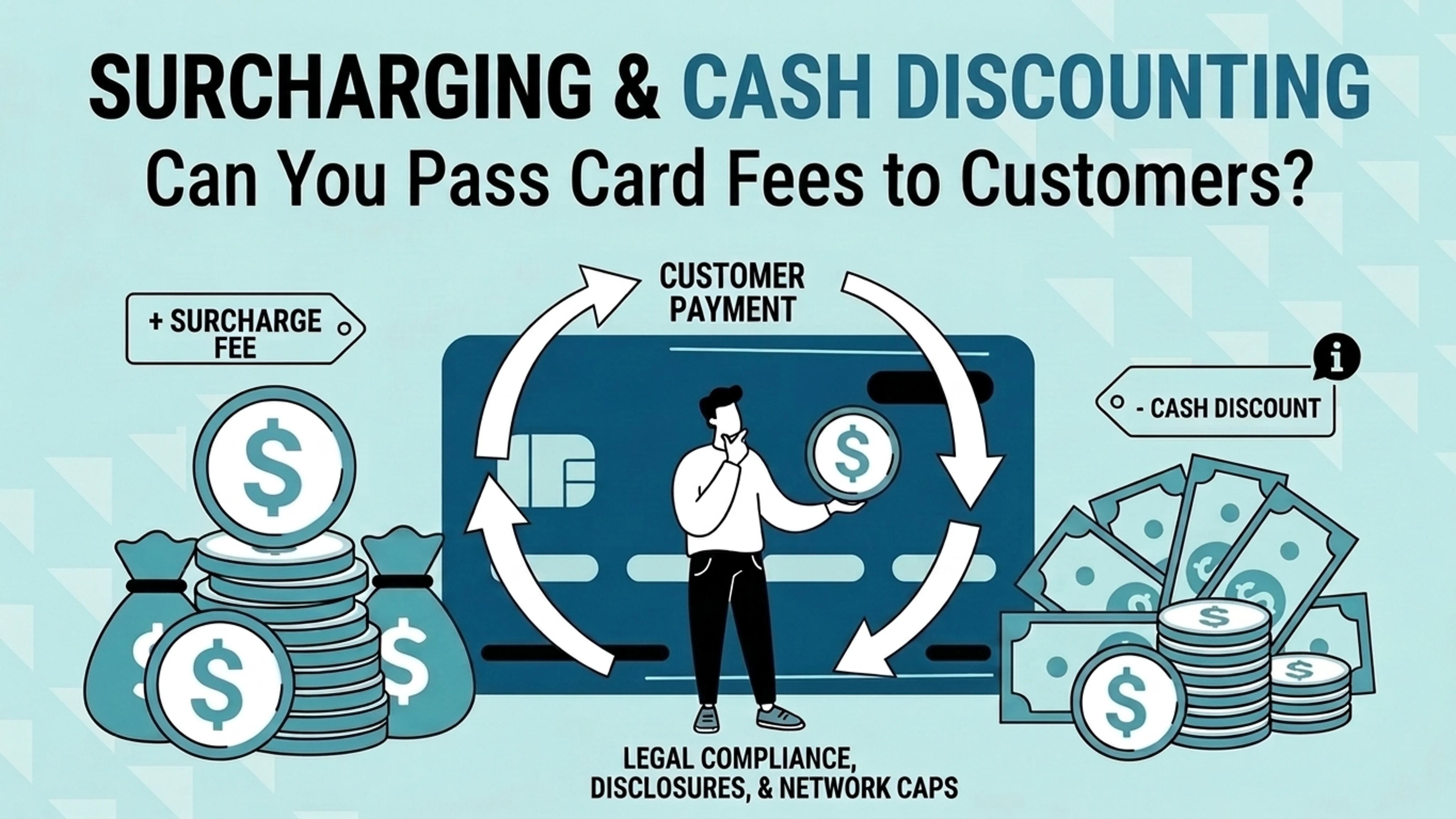
Businesses may be able to pass some credit card acceptance costs to customers through a surcharge — but whether and how they can do so depends on applicable law, card-network rules, and their acquiring or payment-provider requirements. Cash discounting is structured differently: instead of adding a fee for card use, the merchant offers a lower price to customers who pay with an eligible alternative method, such as cash.
The two terms are not interchangeable, and treating them as if they are is where most compliance trouble starts. A surcharge adds to a posted price; a cash discount reduces from one. That difference determines which rules apply.
It gets more layered from there. A program can comply with state law and still violate card-network requirements — or satisfy network rules while conflicting with a state-specific restriction. So the real question isn't "is surcharging legal?" in the abstract. It's whether a specific program satisfies all the applicable requirements at once. This guide walks through each layer: the surcharge-versus-discount distinction, whether surcharging is legal, the card-network rules, disclosures, and how to implement a program without tripping over one of the three rule sets.
Surcharging vs. Cash Discounting at a Glance
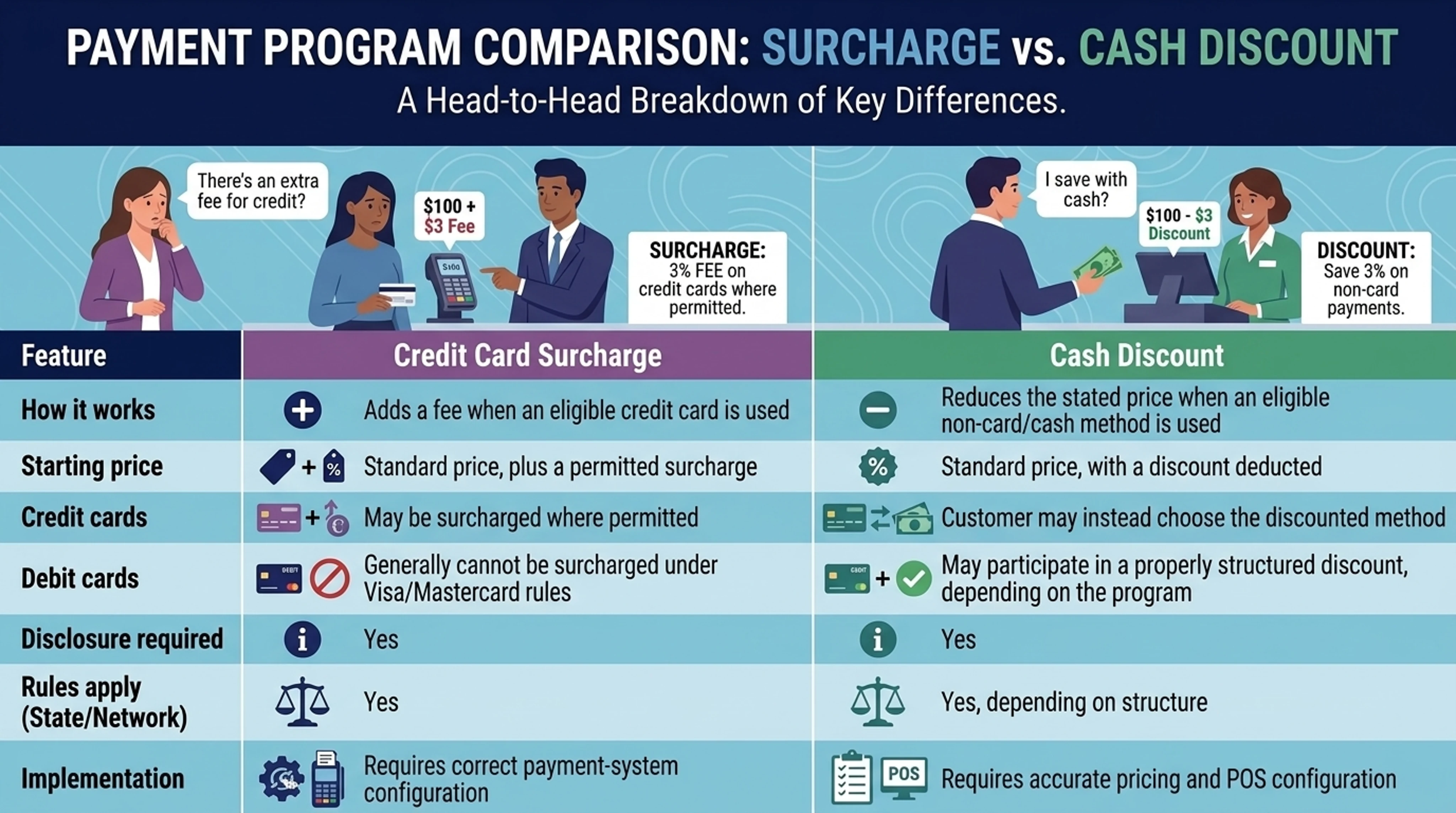
A note on precision, because the details matter here. Under current Visa rules, U.S. surcharging is limited to credit cards — not debit or prepaid — and a Visa surcharge is capped at the lower of the merchant's applicable rate for that card or 3%, with advance notice to the acquirer and required disclosures. Mastercard similarly limits the amount to the merchant's cost of acceptance up to an absolute maximum of 4%, with its own notice and disclosure rules. These are summarized in detail below and were last reviewed August 8, 2026.
Three Rules Must Agree
Before applying a surcharge to any transaction, three separate questions all need a "yes." They operate independently — clearing one does not clear the others.
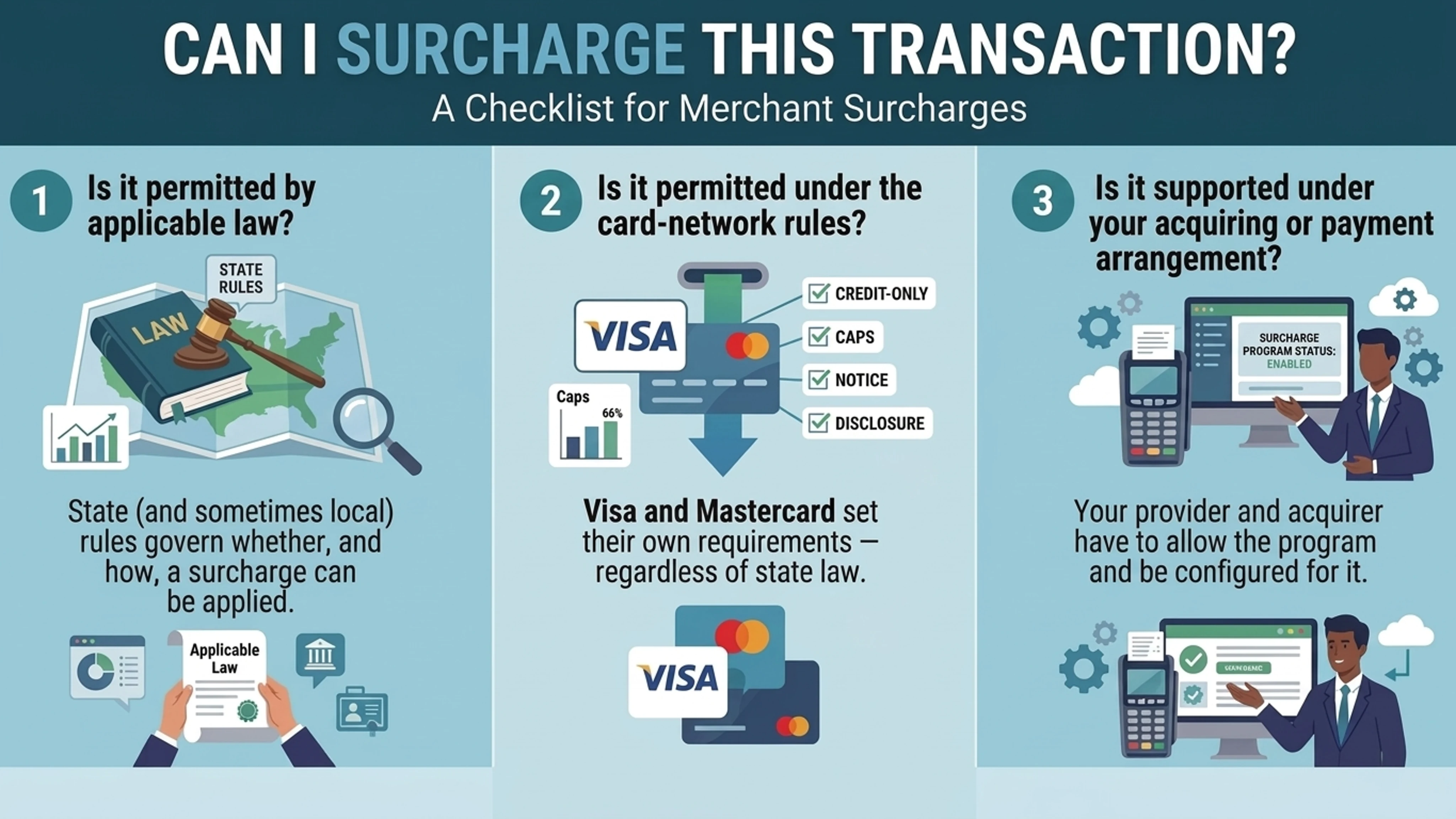
Only when all three agree should a surcharge be applied. This is also the clearest way to see where payment infrastructure fits: it sits between a business's pricing policy and the rules that govern the payment ecosystem, and it can support compliance implementation by applying configured eligibility, pricing, and transaction rules, but the merchant remains responsible for ensuring the program complies with applicable law, network rules, and acquiring requirements.
What Is a Credit Card Surcharge?
Credit Card Surcharge Definition
A credit card surcharge is an additional fee a merchant adds when a customer chooses to pay with an eligible credit card, subject to applicable law and card-network rules.
A surcharge is tied specifically to the customer's choice of payment method. It's an amount added above the posted price because a credit card was used — which is exactly what distinguishes it, legally and operationally, from the other fees it's often confused with.
What a Surcharge Is Not
A surcharge is not the same as any of these, even though the terms get used loosely:
- Cash discount — a reduction from the posted price for paying another way, not a fee added for using a card.
- Convenience fee — under network rules, typically a flat fee for using an alternative payment channel (for example, phone or online) that isn't the merchant's standard one, and it may apply to more card types than a surcharge.
- Service fee — a charge for a service, not for the method of payment.
- Delivery fee — tied to fulfillment, not to card use.
- General price increase — applies to everyone regardless of payment method.
Related: Cash Discount, Convenience Fee, Interchange Fee, Credit Card
What Is Cash Discounting?
Cash Discount Definition
A cash discount is a reduction from the merchant's standard price offered to customers who pay with an eligible alternative method, rather than an additional charge imposed for paying by credit card. The eligible discounted methods depend on the program's structure and applicable requirements; they may include cash, check, or another permitted payment method.
Federal law expressly protects cash discounts: under the Truth in Lending Act (15 U.S.C. § 1666f), a card issuer cannot prohibit a seller from offering a discount to induce payment by cash, check, or similar means, and a properly offered, clearly disclosed discount is not treated as a finance charge. That's a different legal footing from surcharging, which is governed by network rules and state law.
Why Pricing Structure Matters
The distinction lives in the reference price. Consider the same $3 difference, structured two ways:
Surcharge model — Advertised price $100; credit-card surcharge $3; card total $103.
Cash-discount model — Standard price $103; cash discount $3; cash total $100.
Calling a fee a "cash discount" doesn't make it one. What matters is how the price and the discount are structured and disclosed — whether the posted price is the higher (card) price with a reduction for cash, or the lower price with an add-on for cards. Regulators and networks look at the substance, not the label.
Related: Credit Card Surcharge, Debit Card, Acquirer, Merchant Account
Cash Discount vs. Surcharge: What's the Difference?
A surcharge adds an allowed fee to a transaction when an eligible credit card is used. A cash discount instead reduces the standard price when a customer pays with an eligible alternative method. The distinction depends on how prices and discounts are structured and disclosed — not simply on what the merchant calls the program.
In practice, a properly structured cash discount may avoid some restrictions that apply specifically to credit-card surcharges, but it remains subject to applicable pricing, disclosure, and consumer-protection requirements.
Is Credit Card Surcharging Legal?
Credit card surcharging is permitted in most U.S. jurisdictions, but state rules vary, and a few states still restrict or prohibit it. Merchants must also comply with card-network and acquiring requirements — so legality under state law alone does not make a particular surcharge program compliant.
Put simply: "legal in my state" is necessary but not sufficient. The network rules and your acquiring agreement apply on top of state law, and the most restrictive applicable rule is the one that governs.
Credit Card Surcharge Laws: Selected States
This is the layer that changes most often. The table below covers selected states that illustrate the major categories — active prohibitions, bans struck down or narrowed by courts, statutory caps, and disclosure regimes — rather than all fifty. Treat it as a starting map, not a final legal determination, and confirm any state before you rely on it.
On smaller screens, scroll the table horizontally to see every column.
State |
General Status (as of Aug 8, 2026) |
Key Point |
Primary / Authoritative Source |
|---|---|---|---|
California |
Statutory ban enjoined as applied |
California Civil Code §1748.1 remains codified, but enforcement is limited by Italian Colors Restaurant v. Becerra. Under California Attorney General guidance, an optional credit-card surcharge avoidable through another accepted payment method generally is not considered a mandatory fee under SB 478. Applicable disclosure and card-network requirements continue to apply. |
CA AG SB 478 guidance; Italian Colors Rest. v. Becerra |
Texas |
Statutory ban remains codified |
Texas law continues to contain a statutory prohibition on credit-card surcharges. Rowell v. Paxton held the restriction unconstitutional as applied to the plaintiff merchants, but did not categorically invalidate the statute statewide. Debit-card surcharging remains separately restricted. |
Rowell v. Paxton; Tex. Bus. & Com. Code § 604A |
New York |
Permitted, tightly regulated |
GBL § 518; must post the highest (credit) total price; surcharge may not exceed the merchant's cost; posting rules effective Feb 11, 2024 |
NY GBL § 518; Expressions Hair Design (U.S. 2017) |
Florida |
Statutory ban remains codified despite constitutional ruling |
Florida Statutes §501.0117 continues to contain a credit-card surcharge prohibition. However, in Dana's Railroad Supply v. Attorney General, 807 F.3d 1235 (11th Cir. 2015), the Eleventh Circuit held the prohibition unconstitutional under the First Amendment, substantially limiting its enforcement. Applicable card-network, disclosure, and consumer-protection requirements continue to apply. |
Dana's Railroad Supply v. Attorney General, 807 F.3d 1235 (11th Cir. 2015) |
Connecticut |
Prohibited |
Connecticut General Statutes §42-133ff, as amended, prohibits covered payment-method surcharges while permitting qualifying discounts subject to applicable disclosure requirements. |
Conn. Gen. Stat. § 42-133ff; CT DCP guidance |
Massachusetts |
Prohibited |
M.G.L. c. 140D § 28A (eff. April 1, 1996) and 940 CMR 8.06 (eff. September 1, 2017) bar credit-card surcharges; cash discounts permitted |
M.G.L. c. 140D § 28A |
Maine |
Prohibited with exceptions |
9-A M.R.S. § 8-509 (eff. July 1, 2011) prohibits sellers from adding a surcharge for credit- or debit-card use; a genuine discount from the regular price is not treated as a surcharge; However, government entity may impose surcharge for payments made with a credit or debit card if the surcharge is disclosed clearly before the payment and does not exceed the costs associated with providing the credit or debit card service (eff. July 1, 2021) |
9-A M.R.S. § 8-509; Maine Bureau of Consumer Credit Protection |
Colorado |
Permitted, capped |
C.R.S. § 5-2-212 (eff. July 1, 2022) allows either a 2% method or a surcharge based on the actual merchant discount fee, each with its own requirements; mandatory signage/online disclosure + separate receipt line item; no debit/prepaid |
C.R.S. § 5-2-212 |
Minnesota |
Permitted; disclosure-regulated |
Minnesota permits qualifying credit-card surcharges under Minn. Stat. §325G.051, subject to statutory limitations and disclosures. Under Minnesota Attorney General guidance, optional credit-card surcharges reasonably avoidable through another accepted payment method generally are not mandatory fees that must be included in advertised prices under the Price Transparency Law. More restrictive card-network limits continue to apply. |
MN AG Price Transparency FAQ; Minn. Stat. § 325G.051 |
Other states (not listed) |
Not individually covered here |
This guide covers selected states only. For states not listed, merchants should verify current statutes, regulatory guidance, and applicable court decisions. The National Conference of State Legislatures (NCSL) compilation may serve as a starting point, but merchants should consult the underlying legal authorities and qualified legal counsel before implementing a surcharge program. |
NCSL, Credit or Debit Card Surcharges Statutes |
Connecticut, Maine, and Massachusetts maintain statutory restrictions on ordinary merchant credit-card surcharges, subject to applicable exceptions. California, Texas, Florida, and New York have been affected by court decisions that limit or clarify the enforcement or application of their respective surcharge laws. These decisions do not necessarily constitute unrestricted statewide authorization. Merchants must evaluate the current law, applicable judicial decisions, disclosure requirements, card-network rules, and acquiring requirements before implementing a surcharge program.
Card-Network Surcharge Rules Businesses Need to Know
State law is only one layer. Visa and Mastercard each maintain their own surcharge rules, and they are not identical — collapsing them into one generic rule is a common and costly simplification. The summary below focuses on Visa and Mastercard; businesses accepting American Express, Discover, or other payment brands must separately confirm those brands' requirements, including any limitations involving competing brands.
Visa Surcharge Rules
Under Visa's current U.S. rules:
- Surcharging applies to credit cards only — not Visa debit or prepaid cards.
- The surcharge is capped at the lower of the merchant's applicable rate for that card or 3% (Visa reduced this cap from 4% to 3% effective April 15, 2023).
- The merchant must notify its acquirer at least 30 days before beginning to surcharge and follow the acquirer's implementation requirements.
- The surcharge must be disclosed at the point of entry and point of sale (in store and online) and appear as a separate line item on the receipt.
Mastercard Surcharge Rules
Mastercard's current U.S. rules run parallel but differ in the specifics:
- Surcharging applies to credit cards only — not Debit Mastercard or Mastercard prepaid cards.
- The surcharge is capped at the lower of the merchant's average effective cost of acceptance for the card or an absolute maximum of 4%.
- The merchant must give at least 30 days' advance notice to both Mastercard and its acquirer and register the program.
- Disclosure is required at the point of interaction, and the surcharge amount must appear on the receipt.
Card-network rules last reviewed: August 8, 2026. Confirm current caps and requirements directly with the network and your acquirer before implementation.
Can You Surcharge a Debit Card?
Generally, no. Under the major U.S. card-network rules, a credit-card surcharge should not be applied to debit or prepaid card transactions — even when the customer selects "credit" at checkout on a debit card.
It's worth clearing up a common misconception: there is no single federal statute that bans debit-card surcharging. The prohibition comes from Visa and Mastercard network rules (and, in some states, state law), enforced through your merchant processing agreement — not from the Durbin Amendment, which addresses debit interchange and protects discounts rather than banning debit surcharges.
The practical consequence is an infrastructure one. A compliant program has to correctly identify the card type — credit, debit, or prepaid — and apply a surcharge only to eligible cards, rather than adding a percentage whenever a card is presented. That identification is a payment-system capability, not a pricing decision.
Related: Debit Card, Credit Card, Interchange Fee, Payment Processor
How Much Can a Business Charge?
There's no single universal number. The allowed surcharge can depend on the card brand, the merchant's cost of acceptance, the network cap, any state-specific limit, and the acquiring agreement — and the most restrictive of these controls.
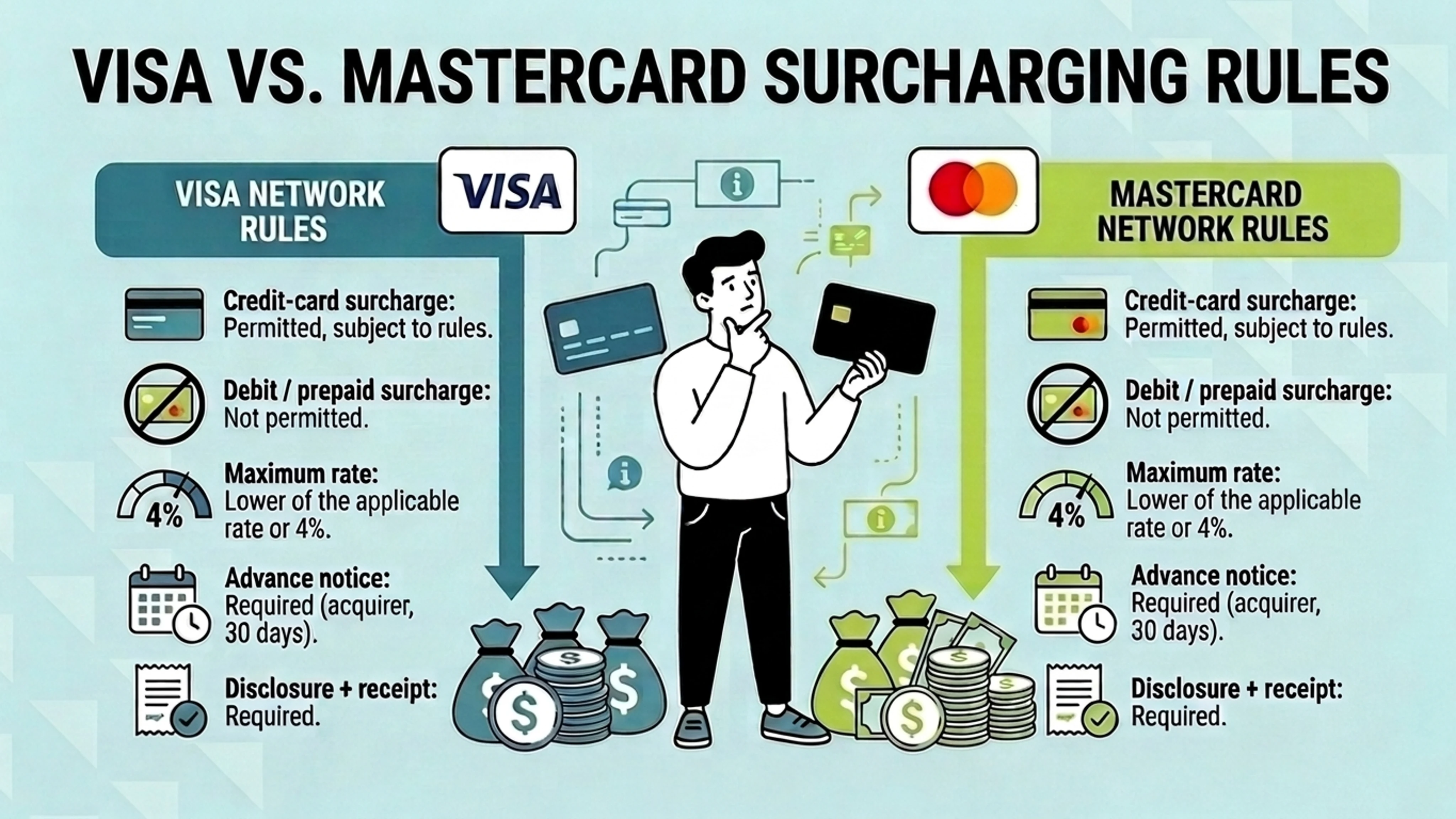
Current as of August 8, 2026. Because state caps (where they exist) and network caps can differ, the operative ceiling for any given transaction is whichever applicable rule is most restrictive.
What Disclosures Are Required?
Surcharging is a disclosure-heavy practice, and requirements come from both networks and jurisdictions. Depending on the rules that apply, disclosure may be required:
- At the store entrance
- At the point of sale
- During online checkout
- Before the transaction is completed
- On the receipt (typically as a separate line item)
- In advertised pricing, where state law requires it
Visa's current U.S. rules, for example, require customers to be clearly alerted to a surcharge at the applicable points in the transaction and require the surcharge to appear on the receipt. Some states go further on how the price itself must be presented — New York requires posting the higher credit price, and "drip pricing" laws in states such as California and Minnesota govern which fees must be built into advertised prices.
Surcharge Program Implementation Considerations
Before implementing a surcharge program, businesses should work with their acquirer/payment provider and qualified legal counsel to evaluate the applicable requirements, including the following operational considerations.
- Check applicable state and local law. Verify restrictions everywhere the business operates or sells.
- Review card-network requirements. Determine which cards may be surcharged and the applicable caps.
- Contact your acquirer or payment provider. Confirm authorization, registration, and the 30-day notice requirements.
- Configure payment infrastructure correctly. The system needs to distinguish credit, debit, and prepaid cards, applicable brands, and eligible transaction types.
- Configure the correct fee. Never assume a generic 3% or 4% — set the amount to what the applicable rules allow.
- Add required disclosures. Online and/or physical signage as applicable, plus checkout disclosure.
- Configure receipts and transaction data. Ensure the surcharge is captured and displayed correctly.
- Test the program. Run credit, debit, wallet, refund, and partial-refund flows before launch.
- Monitor regulatory and network changes. Assign someone to review the program on a schedule.
How Payment Infrastructure Supports Compliant Surcharging
Compliant surcharging isn't only a pricing decision — it's a sequence the payment system has to execute correctly on every transaction:
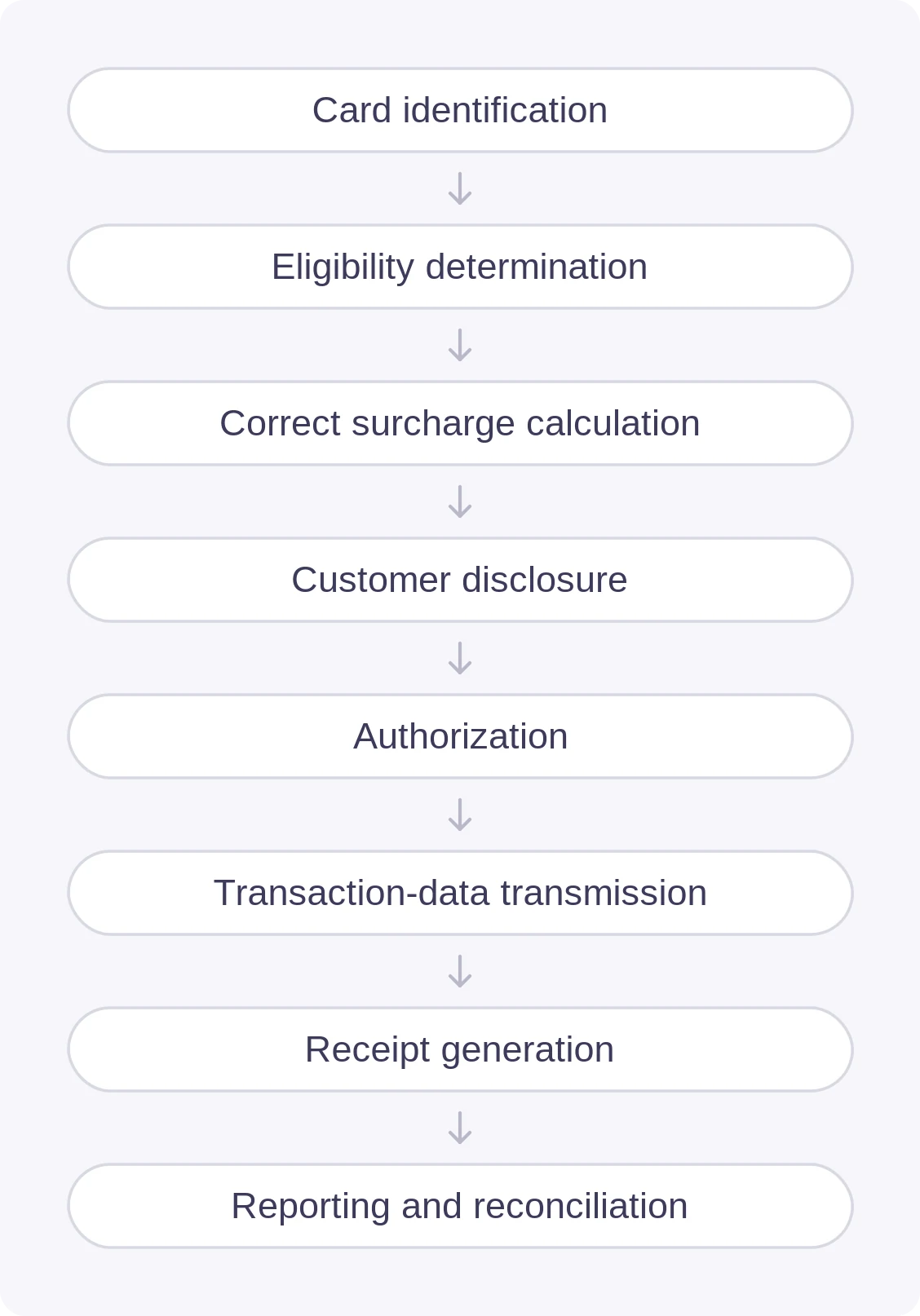
Card identification leads to eligibility determination, then correct surcharge calculation, customer disclosure, authorization, transaction-data transmission, receipt generation, and finally reporting and reconciliation. Miss a step — surcharge a debit card, omit the receipt line item, apply the wrong cap — and an otherwise legal program becomes non-compliant.
That's the quiet point underneath the whole topic: Payment infrastructure is one part of implementing a surcharge program. Correct configuration can support card eligibility, surcharge calculation, disclosures, transaction data, receipts, and reporting, while legal, network, and acquiring requirements must be addressed separately. Cliq's role here is to help businesses understand and configure supported payment capabilities for a pricing strategy, subject to applicable legal, network, and acquiring requirements.
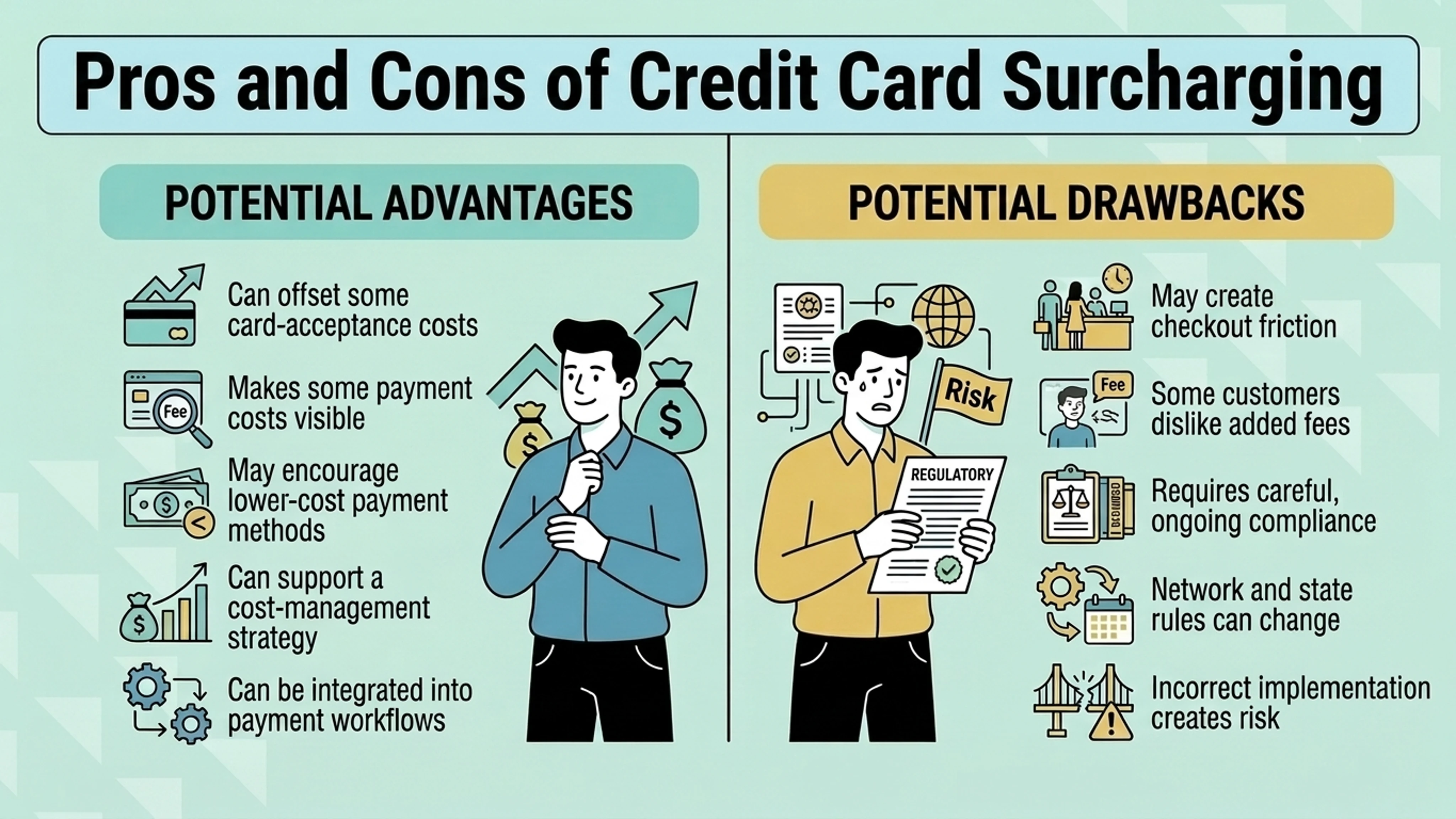
Pros and Cons of Credit Card Surcharging
Pros and Cons of Cash Discounting
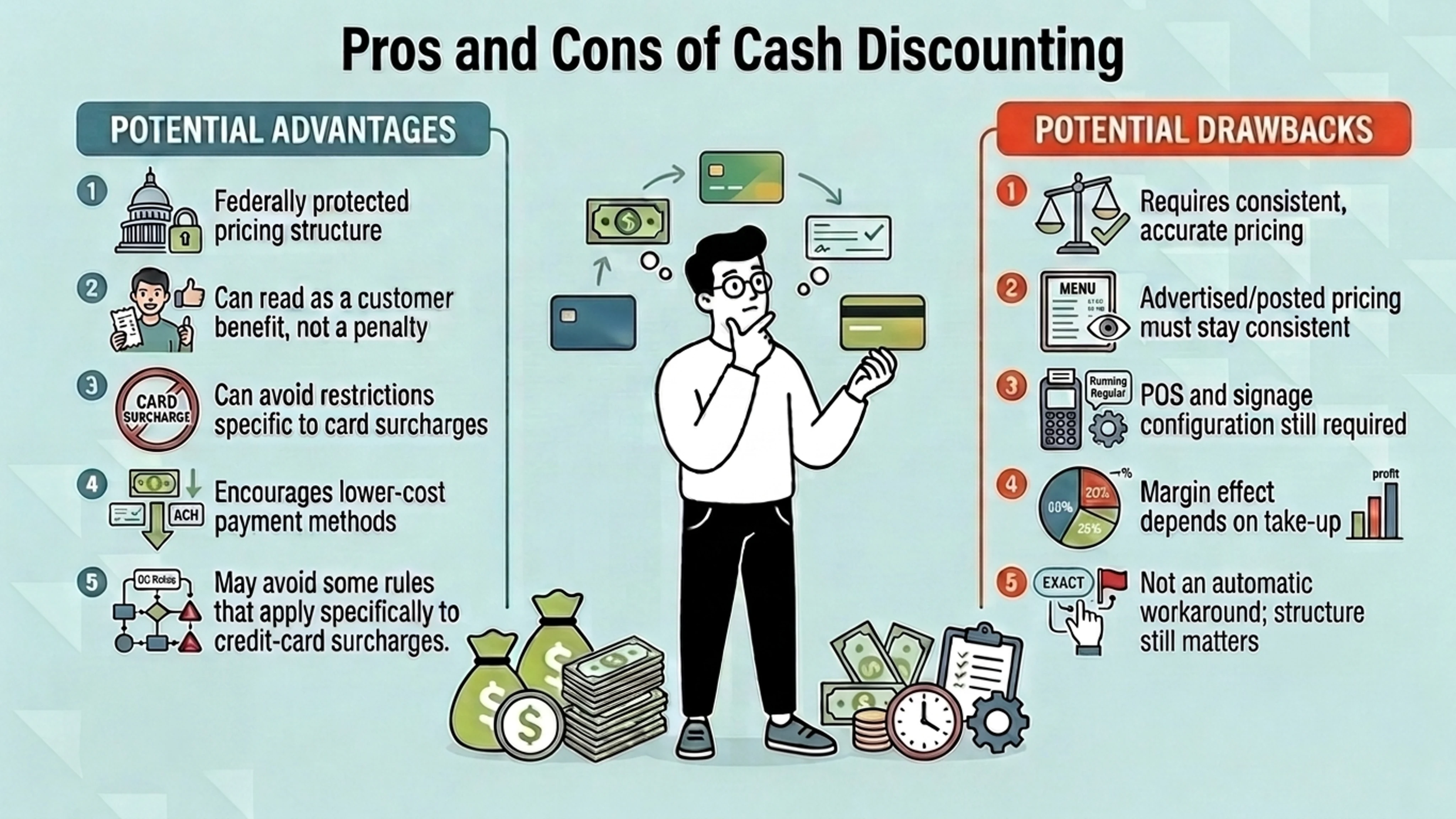
Cash discounting is structured differently from surcharging, but applicable state pricing, disclosure, and consumer-protection requirements still must be evaluated — a discount still has to be a genuine reduction from a posted price, disclosed correctly.
Which Model Is Right for Your Business?
There's no single right answer; it depends on your situation. Weigh:
- The state(s) you operate in
- Online versus in-person commerce
- Average transaction size
- Customer expectations
- Your margin structure
- The mix of debit versus credit transactions
- Your existing payment infrastructure
- Your administrative capacity to monitor and maintain the program
- Your overall pricing strategy
Frequently Asked Questions
Is it legal to charge customers a credit card fee?
In many U.S. states, yes — a credit card surcharge is permitted, though some states restrict or prohibit it and the rules vary. Any surcharge must also comply with card-network rules and your acquiring agreement, so state legality alone doesn't make a program compliant.
What is the difference between a surcharge and cash discount?
A surcharge adds a fee when a customer uses an eligible credit card. A cash discount reduces the standard price when a customer pays with an eligible alternative method. The difference depends on how prices and discounts are structured and disclosed, not on the label.
Can I pass credit card processing fees to customers?
Sometimes, through a surcharge where it's permitted, or indirectly through a cash-discount pricing structure. Both are subject to disclosure rules, card-network requirements, and state law, so the right approach depends on where and how you operate.
Can I surcharge debit cards?
Generally no. Visa and Mastercard rules prohibit applying a credit-card surcharge to debit or prepaid cards, even if the customer selects "credit." There's no single federal statute banning it — the prohibition comes from network rules enforced through your processing agreement.
What is the maximum credit card surcharge?
Under network rules, a Visa surcharge is capped at the lower of your applicable rate or 3%, and a Mastercard surcharge at the lower of your cost of acceptance or 4%. Some states cap it differently, and the most restrictive applicable limit controls.
Do I need to provide advance notice before surcharging?
Yes. Visa requires merchants to notify their acquirer at least 30 days before beginning to surcharge. Mastercard requires at least 30 days' advance notice to both Mastercard and the merchant's acquirer. Your acquirer or payment provider may impose additional onboarding requirements.
Do I need a sign for a credit card surcharge?
Typically yes. Network rules require clear disclosure at the point of entry and point of sale (and at online checkout), plus the surcharge shown on the receipt. Some states add their own posting requirements.
Can I surcharge online transactions?
Where surcharging is otherwise permitted, yes — with disclosure at checkout before the transaction completes and on the receipt or confirmation, subject to the same network and state rules.
Are cash discount programs legal?
Federal law limits a card issuer's ability to prohibit qualifying discounts for payment by cash, check, or similar means. Cash-discount programs must still comply with applicable state pricing, disclosure, and consumer-protection requirements.
Is a convenience fee the same as a surcharge?
No. Under network rules a convenience fee is generally a flat fee for using an alternative payment channel (such as phone or online) that isn't the merchant's standard one, and it can apply to more card types. A surcharge is credit-only, percentage-based, and tied to card choice.
Do surcharge laws vary by state?
Yes, significantly — and they change often. Some states permit surcharging, a few prohibit it, and others regulate how fees must be disclosed. Always confirm the current rule in each state you operate in.
Can my payment processor automatically apply surcharges?
A capable payment system can identify eligible card types, apply the correct amount, add disclosures, and record the surcharge on receipts and in reporting. Correct configuration and ongoing maintenance can support compliant operation, but merchants must also monitor applicable law, network rules, and acquiring requirements.
Conclusion
The distinction is the foundation. Surcharging adds a permitted fee when an eligible credit card is used. Cash discounting reduces the standard price when a customer pays with an eligible alternative method.
Whether either strategy fits depends on far more than a desire to recover processing costs. It depends on state law, card-network requirements, acquiring agreements, disclosures, payment-system configuration, and customer experience — the three rule sets that all have to agree, executed correctly at the transaction level. Understanding those layers is what lets a business choose a pricing strategy it can run compliantly, and keep running as the rules change.
Before adopting surcharging or cash discounting, confirm that your payment setup can apply the appropriate pricing rules, distinguish eligible transaction types, provide the required disclosures, and support accurate reporting. Cliq can help businesses understand and configure payment capabilities that support their pricing strategy, subject to applicable legal, network, and acquiring requirements.
References
All sources retrieved August 8, 2026. This is a fast-moving area; confirm load-bearing claims against the live primary source before publication.
Tier 1 — Primary (statutes, regulators, networks, federal law)
- Visa — Surcharging Credit Cards: Q&A for Merchants (credit-only; lower of applicable rate or 3%, effective April 15, 2023; 30-day acquirer notice; disclosure and receipt requirements).
- Mastercard — Credit Card Surcharge Rules and Fees for Merchants (credit-only; lower of cost of acceptance or 4%; 30-day notice to Mastercard and acquirer; disclosure and receipt).
- Truth in Lending Act, 15 U.S.C. § 1666f — cash-discount protection; discount not a finance charge.
- Durbin Amendment / Regulation II, 12 CFR Part 235 — debit interchange and payment-method discounts (see CRS Report R41913).
- California — AG guidance on SB 478 (hidden fees); Cal. Civ. Code § 1748.1.
- New York — GBL § 518; Expressions Hair Design v. Schneiderman, 581 U.S. 37 (2017).
- Connecticut — CT Dept. of Consumer Protection surcharge guidance; Conn. Gen. Stat. § 42-133ff.
- Colorado — C.R.S. § 5-2-212.
- Minnesota — MN AG Price Transparency Law FAQ; Minn. Stat. § 325G.051.
Tier 2 — Interpretive / maintained compilations
- National Conference of State Legislatures (NCSL) — Credit or Debit Card Surcharges Statutes (maintained state-law compilation; confirm against the underlying statute for load-bearing claims).
- Court decisions: Italian Colors Rest. v. Becerra (9th Cir.); Rowell v. Paxton (W.D. Tex.); Dana's R.R. Supply v. Att'y Gen. (11th Cir. 2015).
So, what's next?
We're ready to get started.